

Key Takeaways
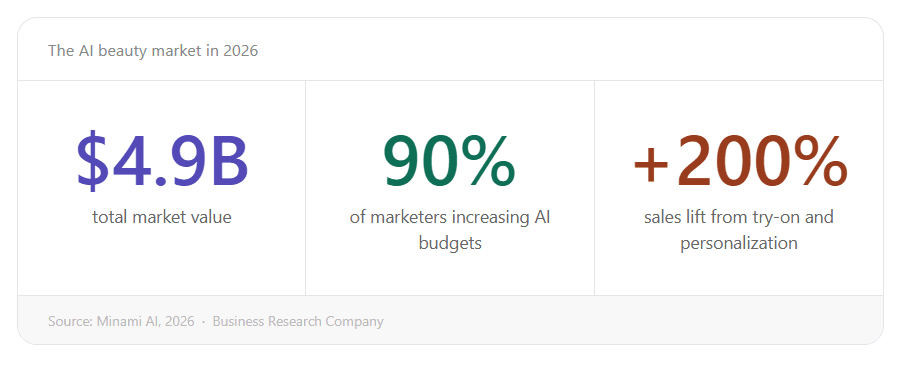
- The AI beauty market is now valued at $4.9 billion, with 90% of marketers increasing their budgets to stay competitive, according to Minami AI's 2026 industry report.
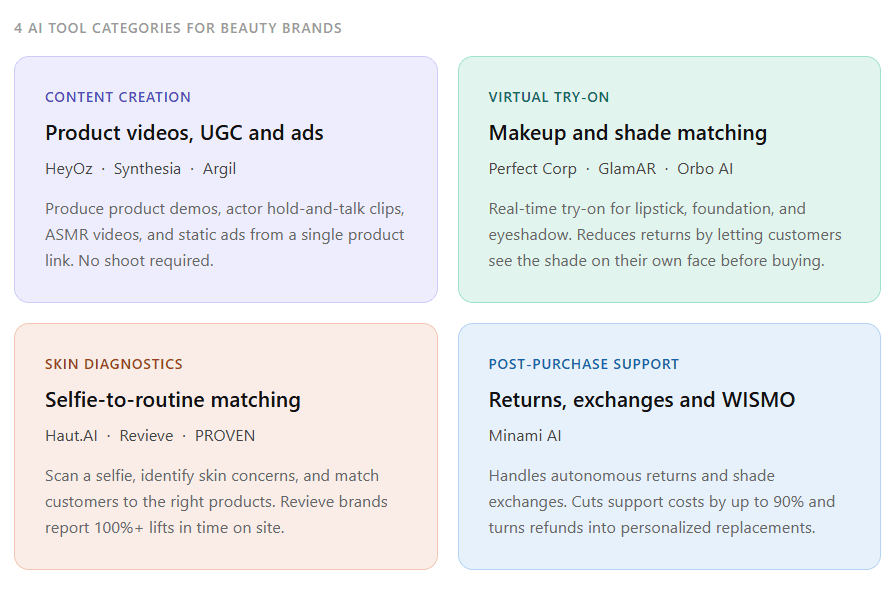
- The best AI tools for beauty brands fall into four buckets: content creation, virtual try-on, AI skin diagnostics, and post-purchase support.
- Personalization and virtual try-ons boost beauty sales by up to 200% by reducing purchase hesitation, which is why the biggest brands like Sephora, L'Oreal, and Estee Lauder are doubling down on them.
- Tools like Perfect Corp, GlamAR, and Haut.AI lead in try-on and skin diagnostics, while HeyOz leads in content production for ads, UGC videos, and product photoshoots.
- Most brands do not need every tool. They need one tool that solves their most expensive problem right now.
Introduction
A skincare founder I spoke with last month was paying $8,000 a quarter for product photoshoots. Six AI tools later, she had cut that bill to under $500 and was producing five times the content. The win was picking the right tool for each job, not stacking every AI app she could find. This guide breaks down the AI tools for beauty brands that are actually worth the budget in 2026.
Why Beauty Brands Are All In on AI This Year
The beauty industry leans on AI harder than most ecommerce verticals. There is a good reason for that.
The category lives and dies on visual proof. Customers cannot smell a perfume through a phone screen. They cannot feel the texture of a serum. They cannot see how a lipstick shade looks against their own skin. Every one of those gaps is a place where AI tools step in.
The dollars back it up. The AI beauty market is valued at $4.9 billion, with 90% of marketers increasing their budgets to stay competitive, and personalization and virtual try-ons boost sales by up to 200% by reducing purchase hesitation. That is not a vanity stat. It is the reason every major beauty brand from Sephora to L'Oreal to Cetaphil has built AI into the core of their digital experience.
There is another piece worth noticing. The Business Research Company reports the AI beauty market is projected to grow at a CAGR of 19.6% from 2023 to 2028. Brands that wait another year to adopt these tools will be playing catch up against competitors who already locked them in.
The Best AI Tools for Beauty Brands by Category
There is no single AI tool that covers everything. The smartest founders pick one tool per job. Here are the four categories that matter most in 2026.
Content Creation: HeyOz, Synthesia, Argil
This is where most beauty brands burn the biggest budgets. Studio shoots. Influencer fees. Editing teams. Tools like HeyOz produce product videos, UGC clips, static ads, and AI actor demos from a single product link. Synthesia turns scripts into videos with AI avatars and voiceovers in 140+ languages, with 230+ AI avatars varied in age, ethnicity, and gender to make marketing videos more inclusive. Argil is built specifically for UGC video at scale.
For beauty brands that need volume, the differentiator is whether the tool can show your actual product being held, applied, or demonstrated on screen. HeyOz handles realistic product handling for serums, jars, lipsticks, and packaging. Most generic tools do not.
Virtual Try-On: Perfect Corp, GlamAR, Orbo AI
Virtual try-on is the highest ROI category for makeup and skincare brands selling online. The number one reason for makeup returns is "the color didn't look like the photo," and virtual try-on solves this instantly.
Perfect Corp is the enterprise leader, used by major retailers globally, and runs on AgileFace technology that tracks 200+ facial landmarks in real time. GlamAR is the friendlier option for smaller brands and has a native Shopify app. GlamAR's AI-powered skin analysis tool can identify 14+ skin issues using 94 algorithms and evaluate 150+ unique multidimensional facial biomarkers.
If your products include lipstick, foundation, eyeshadow, or anything color-based, this category is non-negotiable.
AI Skin Diagnostics: Haut.AI, Revieve, PROVEN
For skincare specifically, diagnostic tools have moved past gimmick stage and into real conversion infrastructure. Revieve brands report up to 100%+ increases in time spent on-site and significantly higher average order values, while PROVEN's AI uses 47 factors including zip code to calculate local water hardness, humidity, UV index, and pollution levels for custom formulas.
Haut.AI offers SkinGPT for realistic skin simulations, including aging progression and product effects over time. The pitch to customers is simple. Take a selfie, get a diagnosis, get matched to the right products.
Post-Purchase and Support: Minami AI
This one is less obvious but worth a mention. Beauty products break in transit more than most categories. Glass bottles, liquids, shade mismatches. Minami AI handles autonomous returns and shade exchanges, cuts support costs by up to 90%, and turns returns into personalized exchanges based on purchase history.
Most beauty founders skip this category until refund rates start eating margin. If your support team is drowning in WISMO tickets and damaged delivery claims, this is where to look.
What to Avoid When Stacking AI Tools
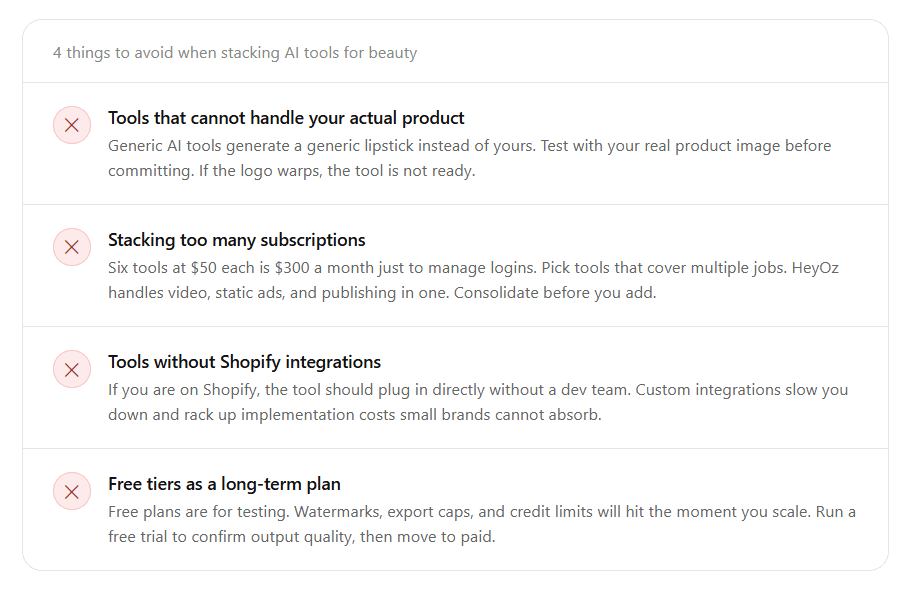
A few flags to watch for when you are evaluating which tools to add.
Avoid tools that cannot handle your actual product. Some generic AI tools will generate a generic lipstick instead of yours, or warp your packaging label halfway through a video. Test with your real product image before you commit. If the logo looks wrong, the tool is not ready.
Avoid stacking too many subscriptions. A brand using six AI tools at $50 each is paying $300 a month just to manage logins. Pick tools that do multiple jobs well. HeyOz combines video generation, static ad creation, and social publishing in one. Revieve covers skin analysis, try-on, and recommendations in one. Consolidation matters more than feature lists.
Avoid tools without ecommerce integrations. If you are on Shopify, the tool should plug in directly without a dev team. Most of the leaders here have native Shopify apps now. Custom integrations slow you down and rack up implementation costs that small brands cannot absorb.
Avoid free tiers as your long-term plan. Free plans are great for testing. They are not great for production. Watermarks, export caps, and credit limits will hit you the moment you scale.
How to Pick the Right AI Tool for Your Beauty Brand
The honest answer matters more than the comparison chart.
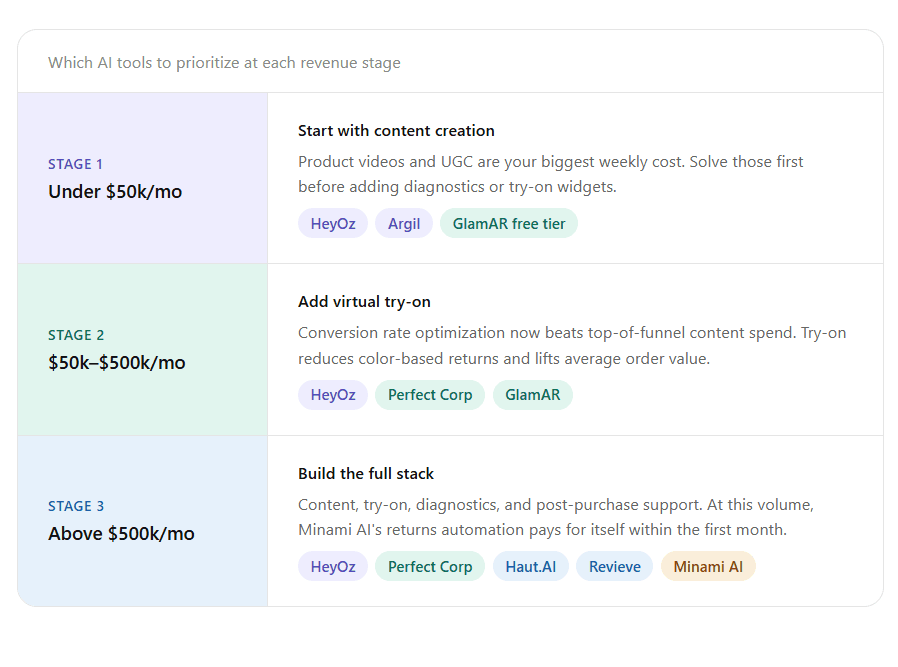
If you are pre-launch or under $50k a month in revenue, content creation is where to start. You need product videos, UGC, and static ads more than you need a skin diagnostic widget. HeyOz or Argil for content, plus a free virtual try-on widget like GlamAR's basic plan.
If you are between $50k and $500k a month, add virtual try-on as your second tool. Perfect Corp if you are makeup-heavy. GlamAR if you are skincare and want diagnostics included. This is the stage where conversion rate optimization beats top-of-funnel content spend.
If you are above $500k a month, build the full stack. Content, try-on, diagnostics, and post-purchase support. The pattern among the fastest-growing beauty brands is consistent: they pick the tool with the clearest ROI, get it live, measure the impact, and expand from there.
A practical note. L'Oreal Paris uses Skin Genius and Beauty Genius to scan selfies and provide skincare regimens based on specific skin conditions, while Sephora partnered with ModiFace for foundation shade matching. The biggest brands do not stack random tools. They pick category leaders and build around them.
How HeyOz Works for Beauty and Skincare Brands
HeyOz is built for the content side of the AI tools for beauty brands stack. It handles the hardest part for skincare and makeup founders, which is producing realistic content that shows the product being used, held, or applied on a real-looking person.
Here is the exact flow:
Paste your product URL. HeyOz extracts your product images, descriptions, brand colors, and audience details automatically.
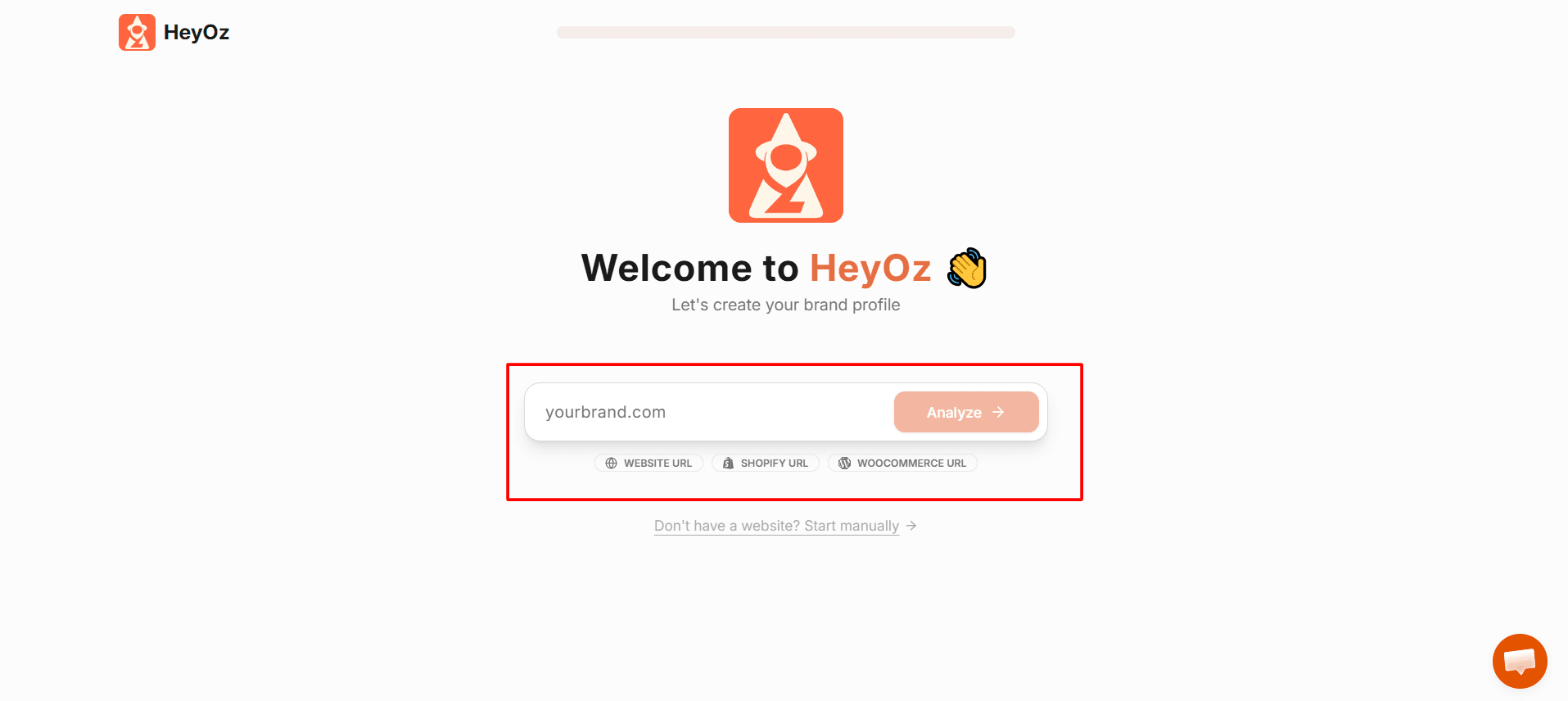
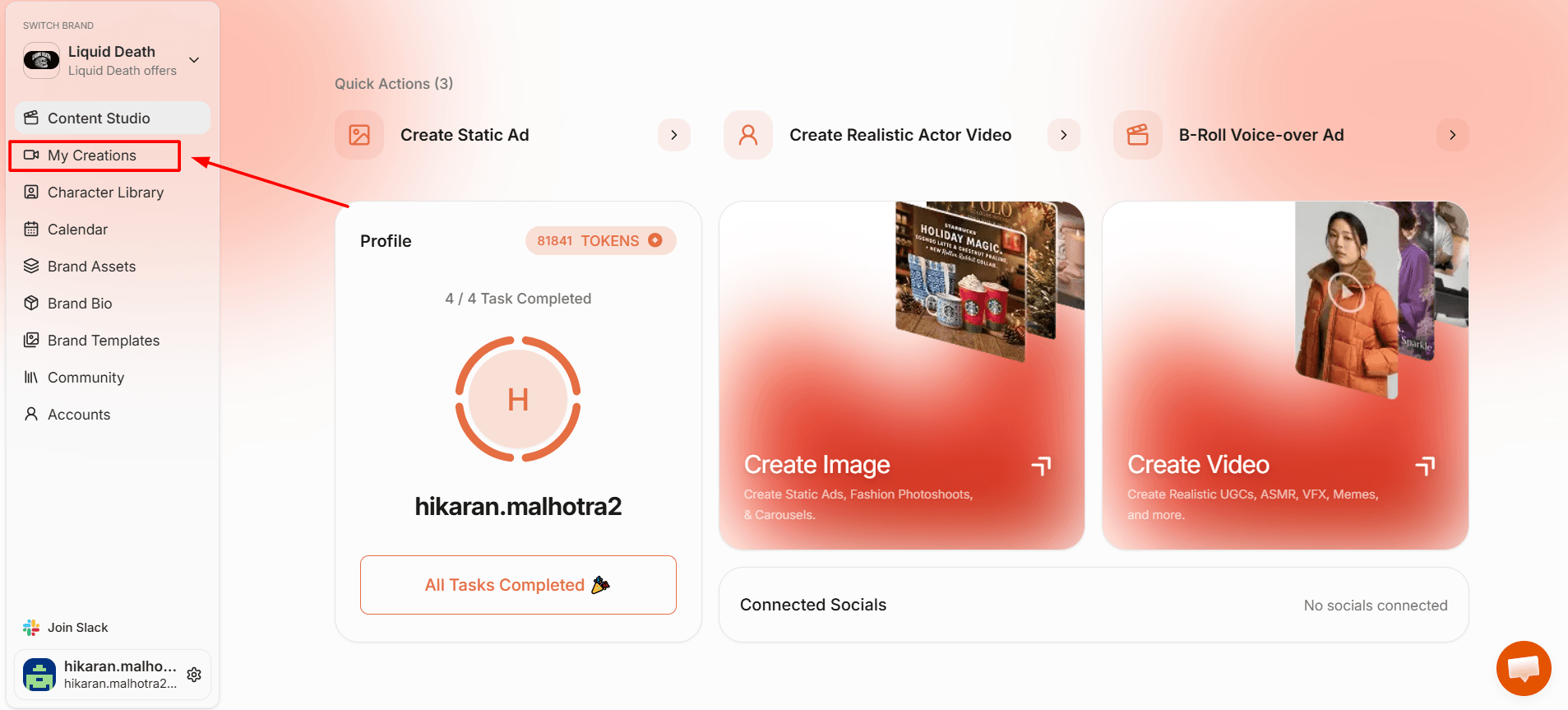
Open the Content Studio and pick a format. UGC videos, static ads, fashion photoshoots, product in hand visuals, talking avatar clips, ASMR product handling, or B-roll voiceover ads.
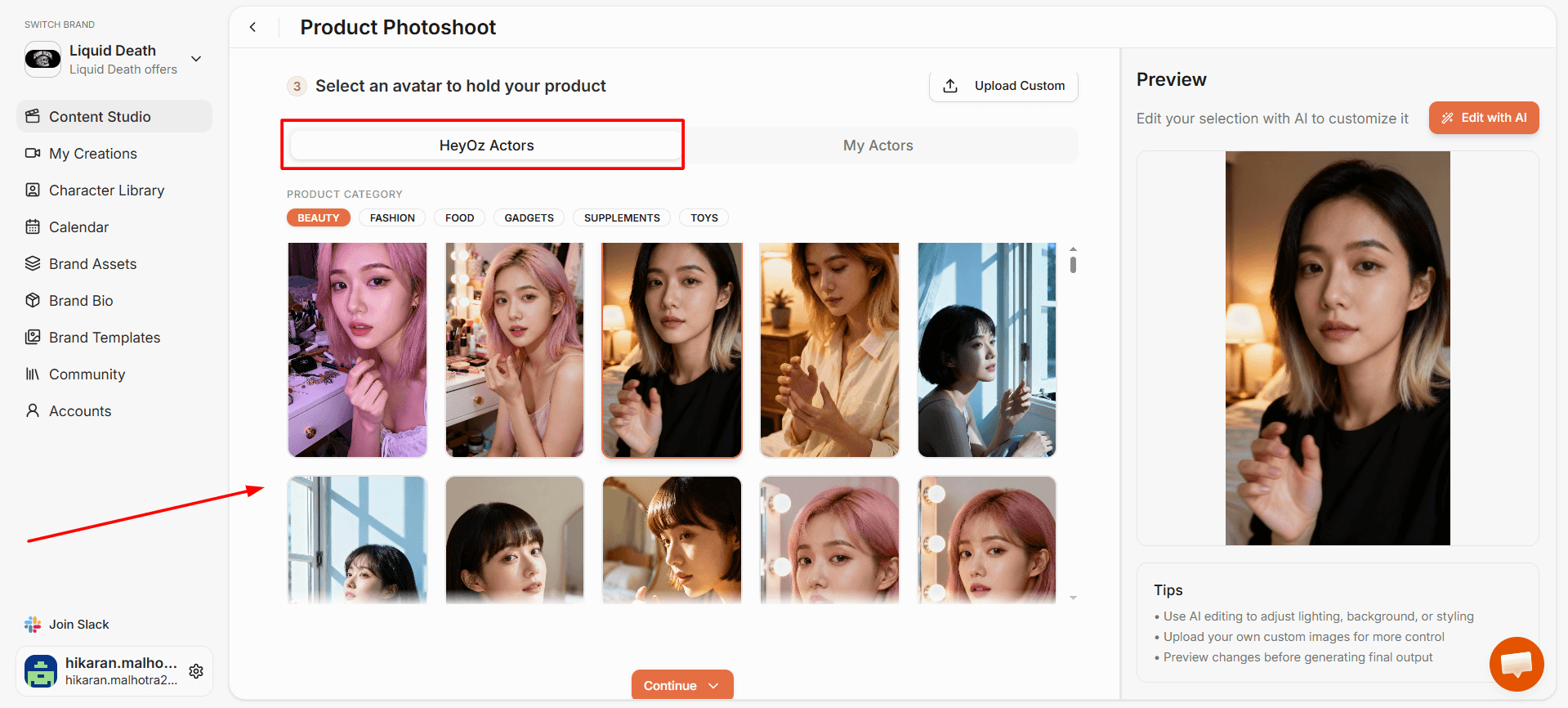
Pick your AI actor from a diverse library, then upload your product image so the actor holds or applies your actual product on screen.
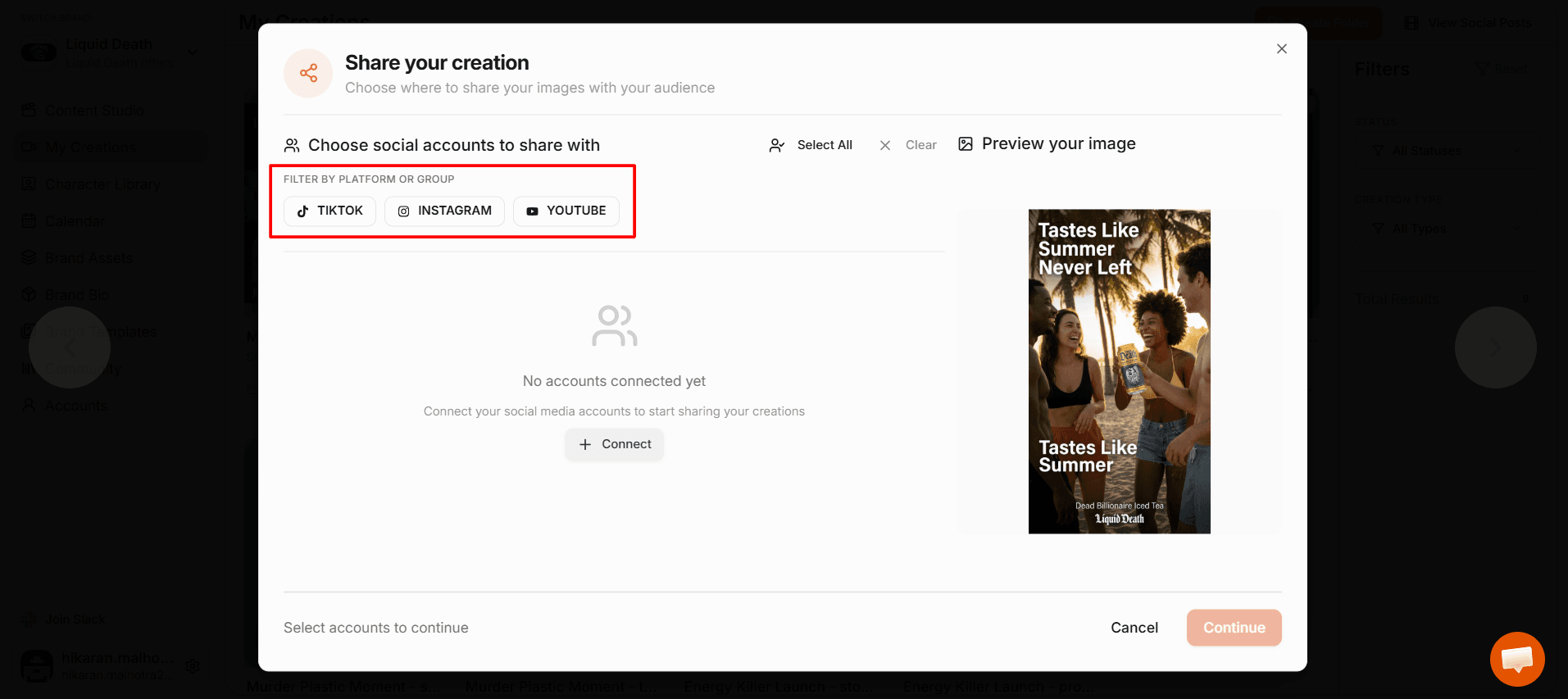
Generate, edit inside the built-in video and image editor, and publish directly to TikTok, Instagram, YouTube, and Facebook.
Why Beauty Brands Pick HeyOz
- Realistic AI actors can hold and demonstrate your actual serums, lipsticks, jars, or compact products, which most generic tools fail at.
- Diverse model library covering different ethnicities, skin tones, ages, and looks, so every customer sees someone who looks like them.
- ASMR product handling videos, fashion photoshoots, and influencer-style hold-and-talk content built in.
- Clean watermark-free exports on all plans, including the free trial.
- One subscription replaces a designer, video editor, and scheduler, starting at $44.99 a month.
Try a free trial at HeyOz.com and produce your first product video this afternoon.
FAQs
What are the best AI tools for beauty brands just starting out?
Start with content creation since that is your biggest weekly cost. HeyOz handles product videos, UGC, and static ads in one place. Add a free virtual try-on widget from GlamAR if you sell color cosmetics. Skip the enterprise tools until your monthly revenue can absorb them.
Can AI tools really replace traditional product photoshoots?
For most product types, yes. Tools like Nightjar generate diverse models of any age, ethnicity, or skin type with hex-code accurate product colors, replacing studio shoots that previously cost $20,000+. HeyOz does the same for video. Reserve traditional shoots for hero campaign assets where you need a specific creative director and brand vision in the room.
How much should beauty brands budget for AI tools?
Smaller brands can run a strong stack for $100 to $200 a month. HeyOz at $44.99, a basic skin analysis widget, and a free scheduling layer. Enterprise tools like Perfect Corp and Revieve quote based on traffic and integration scope, which can run into thousands monthly. Match your spend to your revenue stage, not the hype.
Will customers know my content is AI-generated?
The good tools produce content that is hard to distinguish from real photography or video. The bad tools produce content that screams AI. The difference is product accuracy, motion realism, and avatar quality. Test with your actual product before committing. If your customers can tell, your tool is not good enough.
About the author
Ahad Shams
Ahad Shams is the Founder of HeyOz, an all-in-one ads and content platform built for founders and small teams. He has worked across consumer goods and technology, with experience spanning Fortune 100 companies such as Reckitt Benckiser and Apple. Ahad is a third-time founder; his previous ventures include a WebXR game engine and Moemate, a consumer AI startup that scaled to over 6 million users. HeyOz was born from firsthand experience scaling consumer products and the need for a unified, execution-focused marketing platform.