

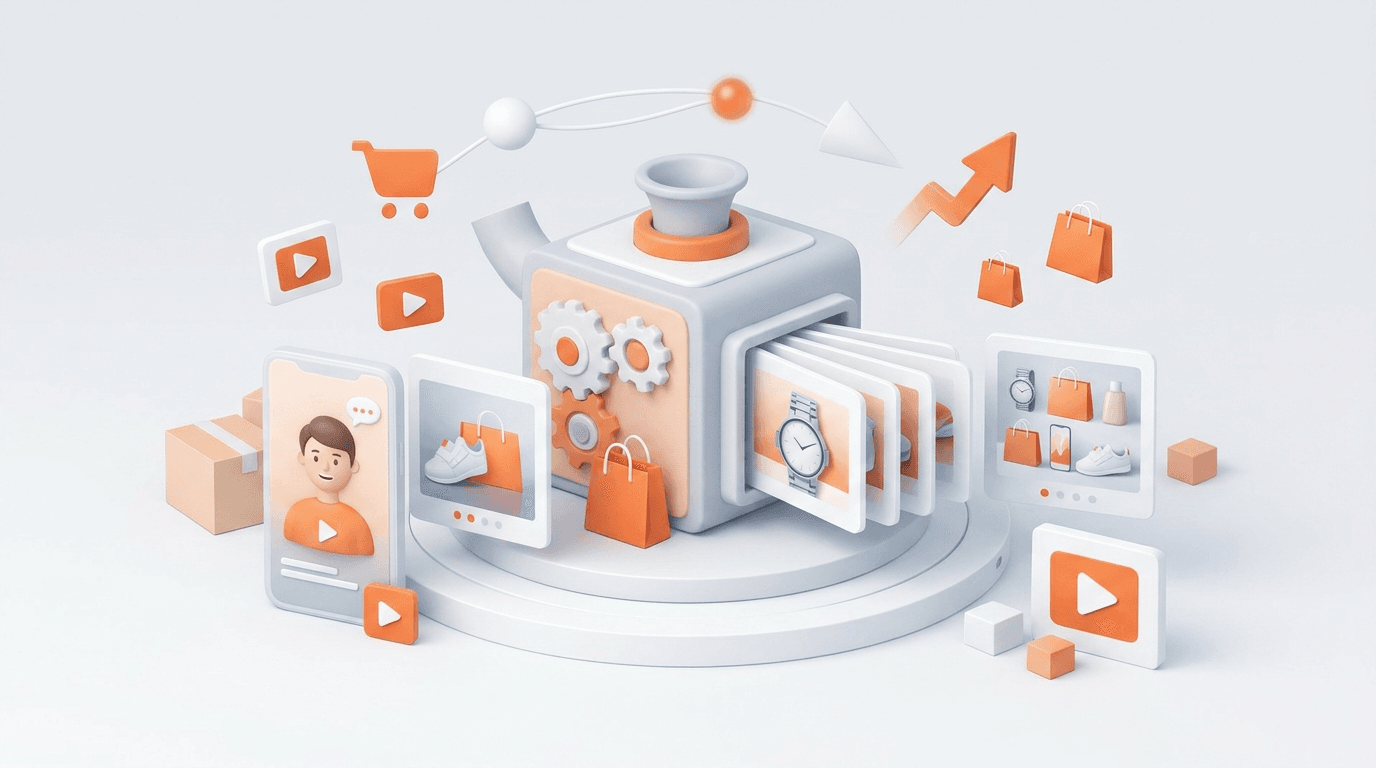
We run this across more than 100 clients, and it has generated over $10M through Meta ads for service-based businesses. This is every step, documented. Most agencies still build creative the slow way: one designer, one copywriter, one strategist, a week per client, and maybe five new creatives if the week goes well. This system produces 30 or more per client in one sitting, across UGC, static ads, carousels, product demos, memes, talking heads, and product photoshoots. Claude runs the strategy. HeyOz runs the production. You point it at a product page and direct.
This document hands you the full playbook, the format matrix, and the exact prompts for every format, ready to paste and produce.
Read time: 9 minutes.
How the engine works
Two engines, one product page.
- Claude is the strategist. It reads the product, maps the audience, writes the hooks, builds script and copy variations across angles and funnel stages, and outputs a HeyOz-ready brief for every format.
- HeyOz is the production studio. It renders UGC videos with AI actors, generates static ads, carousels, and product photoshoots, and ships batch variations across avatars, hooks, and tones.
Claude thinks and briefs. HeyOz produces. One product becomes 30 or more creatives before lunch, all on-brand, all built to test. The rest of this document is the exact workflow: pick the formats, load the brand once, run the prompt for each format, render in HeyOz, then multiply the winners and test them on a schedule.
The creative selection matrix
Not every product needs every format. Match the format to where the buyer is.
Cold traffic (does not know you yet). Goal: stop the scroll and earn attention.
- UGC videos with AI actors: best for DTC and impulse products. Native feel, hides that it is an ad.
- Meme ads: best for low-consideration products and younger audiences. Pure pattern interrupt.
- Talking head videos: best for founders, services, and B2B. Build trust fast with a face and a claim.
Warm traffic (problem-aware, weighing options). Goal: clarity and proof.
- Carousels: best for products with several benefits or steps. Swipe-through teaching.
- Product demos: best for anything easier to show than to tell. Software, gadgets, before and after.
- Static ads: best for a single sharp claim or offer. Cheap to test many angles fast.
Hot traffic (ready, needs a reason to act now). Goal: desire and urgency.
- Product photoshoots: best for premium and visual products. Make it look worth the price.
- Static offer ads: best for closing. Lead with the guarantee, the discount, or the proof.
Quick rule: cold wants native and entertaining, warm wants clarity, hot wants desire and a reason to act now.
Before you start: load the brand once
Every prompt below is sharper when Claude already knows the product. Open one Claude session, paste this once, and keep it open. Every format prompt pulls from it.
You are my senior creative director. Hold this context for our whole session and never lose the thread. Every brief and script you write pulls from it.
PRODUCT URL: [paste your product page]
Read the page, then confirm back to me:
- PRODUCT: what it is, the price, and the main action (purchase, book a call, trial, install)
- THE PROMISE: the single strongest benefit in plain words
- WHY IT IS DIFFERENT: the one thing competitors cannot easily claim
- PROOF: results, numbers, reviews, or credibility on the page. If there are none, mark where I need to add them.
- THE BUYER: who this is for and the moment they decide to buy
- SEGMENTS: 3 to 5 sub-groups who buy this
- BRAND VOICE: the tone of the page, so everything matches it
Once you confirm, hold all of it. I will ask you for one creative format at a time.
The UGC build prompt
This is the core of the system: audience research, hooks, scripts, and render-ready briefs in one pass. Run it right after the brand context.
Using the brand context you are holding, build a full UGC batch.
STEP 1, AUDIENCE: for each segment, give me the top pain in their own words, the deeper desire underneath, and the main objection.
STEP 2, HOOKS: write 10 scroll-stopping hook lines, spread across the segments. Each is the exact first line of a video, built to stop the scroll in 3 seconds. Label each with its segment.
STEP 3, SCRIPTS: expand each hook into a full script, beat by beat:
- HOOK (0 to 3 seconds): the exact opening words
- AGITATION: two or three lines that make the pain real, in the buyer's voice
- PRODUCT REVEAL: the product as the fix, naturally, not an ad read
- CTA: the closing line and the action
Keep each script to 15 to 30 seconds of speech, real creator voice, first person, contractions.
STEP 4, RENDER BRIEF: for each script add a HeyOz-ready line: SUGGESTED AVATAR (the presenter that fits), VOICE AND TONE (for example excited, calm and honest, matter-of-fact), and FORMAT (talking head, green screen, or demo overlay).
Rules: every script a different angle, not a reword. Never invent a statistic or review. Where proof is needed, write [INSERT REAL RESULT].
The exact prompts for every other format
Same session, same brand context. Ask for one format at a time and paste the matching prompt. Each one outputs a brief you drop straight into HeyOz.
Static ads.
Using my brand context, write 5 static ad concepts, each a different angle.
For each:
- ANGLE: the idea in one line
- HEADLINE: the on-image hook, under 8 words
- SUPPORTING LINE: one line of proof or twist
- PRIMARY TEXT: the caption, 2 to 4 sentences
- CTA: the button or closing line
- VISUAL DIRECTION FOR HEYOZ: the scene, the layout, where the product and text sit, the mood and palette
Keep headlines short so they render cleanly. Never invent proof; mark [INSERT REAL RESULT] where needed.
Carousels.
Using my brand context, design 3 carousel ads, 4 to 6 slides each.
For each carousel:
- THE ANGLE and who it targets
- SLIDE BY SLIDE: the on-slide text and the visual direction for each slide, plus the reason someone swipes to the next
- COVER SLIDE: must earn the first swipe
- FINAL SLIDE: the CTA
- CAPTION: the primary text that runs with it
Build each to teach one idea across the swipes. Give HeyOz-ready visual direction per slide.
Product demos and talking heads.
Using my brand context, write 3 demo or talking head scripts.
For each:
- FORMAT: talking head, or screen and product demo
- HOOK (0 to 3 seconds): the exact opening words
- THE WALKTHROUGH: the 3 to 5 beats that show the product working or prove the claim
- THE PROOF MOMENT: where a real result lands, marked [INSERT REAL RESULT] if needed
- CTA: the close
- HEYOZ RENDER NOTE: suggested avatar or presenter, voice and tone, and any on-screen text
Keep it concrete and specific to the product, spoken like a person, not a brochure.
Meme ads.
Using my brand context, write 5 meme-style ad concepts for a green screen or reaction format.
For each:
- THE SETUP: the relatable, slightly funny situation
- THE TEXT ON SCREEN: the caption or meme line, short
- THE TURN: how the product enters as the punchline or the fix
- WHY IT WORKS: the pattern it interrupts
- HEYOZ RENDER NOTE: format, avatar or scene, and tone
Keep it native and funny, never corporate. If a line feels like an ad, rewrite it.
Product photoshoots.
Using my brand context, write 5 product photoshoot concepts for HeyOz to generate.
For each:
- THE SHOT: the scene and styling in one clear description
- MOOD: lighting, palette, premium or playful, clean or lifestyle
- COMPOSITION: how the product sits, the angle, the background, the props
- USE: where this image runs (static ad, carousel slide, landing page)
Make the product the hero and make it look worth the price. Keep each concept distinct.
The HeyOz production workflow
With briefs in hand, HeyOz turns each one into a finished creative.
- Load the brand. Open HeyOz and paste the same product URL. It reads the page and pulls your images, copy, and brand details automatically.
- Pick the format. Choose the HeyOz format that matches the brief: UGC, static, carousel, photoshoot, and so on.
- Cast and match. For video, pick the avatar and set the voice and tone from the brief. Match the face to the segment.
- Render. HeyOz produces the finished creative, with natural lip sync on video.
- Keep and cut. Keep the takes where the delivery feels human and the product reads clearly. Regenerate the rest. Export sized for TikTok, Instagram, and Meta.
A brief becomes a finished, on-brand creative in minutes.
The batch variation system
This is where one product becomes 30 or more. You do not create more concepts. You multiply the ones that work.
The formula per product is different avatars, times different hooks, times different tones.
- Hooks: the ten from the UGC build.
- Avatars: render the winners with several presenters, one per segment or look.
- Tones: render each in a few deliveries, for example excited, calm and honest, and matter-of-fact.
Ten hooks by five avatars by three tones is 150 variations from a single product, all built to test against each other. The rule that keeps it sane: multiply winners, not everything. Render the ten core hooks lightly first, find the two or three angles that get traction, then pour the avatar and tone variations into those. Volume behind a proven angle is scale. Volume behind a dead angle is noise.
The 7-day testing framework
Volume is useless without a way to read it. Here is the framework, with the exact checkpoints.
Days 1 and 2, launch. Put the core angles live, one ad group per angle, on small and even budgets. Test angles first, not avatars.
Day 3, first kill. Check hook rate, meaning the percentage who watch past three seconds, and cost per result.
- Kill any angle with a hook rate under 25 percent or a cost per result more than 1.5 times your target. The angle is wrong, not the avatar.
- Keep every survivor.
Days 4 to 6, multiply the survivors. For each surviving angle, render the avatar and tone variations. Now you test execution: which face and which delivery sells the winning angle best.
Day 7, scale and cut.
- Scale any ad at or below your target cost per result. Raise its budget and move its angle and avatar into the next batch.
- Kill anything still above 1.2 times target after a full week.
- Bank the winners. Save the angle, the hook, the avatar, and the tone as a proven combination, and seed the next batch with it.
Repeat weekly. Every cycle your inputs get sharper, because you only ever build on what already won.
What makes these creatives convert
- Real voice. If a script or caption sounds like an ad, it is dead on arrival.
- One angle per creative. Ten sharp angles beat one angle rendered ten ways.
- The first three seconds are the whole game on video, and the headline is the whole game on static.
- Match the avatar and the format to the buyer, not to your taste.
- Never fake proof. A real number or review beats a clever line with nothing behind it.
- Test angles before executions. Find the winning idea first, then multiply the face, the voice, and the format.
Get the full system running
You now have the entire playbook. If you want the studio that produces it, this is exactly what HeyOz was built for, and it is what generated over $10M through Meta ads for the service businesses we run it for.
Self-serve: paste a product URL, pick a format, and produce your creatives yourself, from under a dollar each. Plans start at $44.99 a month. Start at heyoz.com.
Done-for-you: our team runs the strategy, the scripts, and the production end to end, and treats your ad account like a testing engine, not a portfolio.
You commented ADS, so this playbook is already yours. Book a walkthrough and I will build your first batch with you live.
Book a walkthrough: calendly.com/heyoz/quick-meeting
Start now: heyoz.com
About the author
Ahad Shams
Ahad Shams is the Founder of HeyOz, an all-in-one ads and content platform built for founders and small teams. He has worked across consumer goods and technology, with experience spanning Fortune 100 companies such as Reckitt Benckiser and Apple. Ahad is a third-time founder; his previous ventures include a WebXR game engine and Moemate, a consumer AI startup that scaled to over 6 million users. HeyOz was born from firsthand experience scaling consumer products and the need for a unified, execution-focused marketing platform.