


TL;DR
Find an ad your competitor has been running for months. Break down why it works: the first three seconds, the pacing, the way it asks for the sale. Then rebuild that skeleton with your product, your script, and your visuals. HeyOz handles the rebuild part in minutes.
Key Takeaways
- Cloning a competitor ad means copying its structure, not its content. Hook, pacing, CTA placement, and offer angle. Never the script, footage, or brand assets.
- The Meta Ad Library is free and public. Every ad your competitors run is sitting there waiting to be studied.
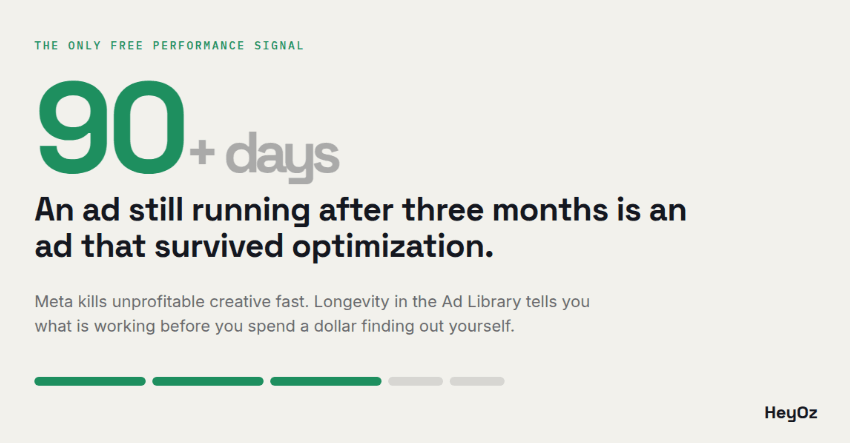
- Ads that run for 90 days or longer are usually profitable. That is your signal for what to clone.
- HeyOz turns a proven structure into a finished video ad in minutes, with realistic actors who hold your actual product.
- Copying creative assets directly is copyright infringement. Copying a format is standard advertising practice.
Introduction
A DTC supplement brand noticed a rival running the same 22 second video ad for four straight months. Same hook. Same cut at the eight second mark. Same closing offer.
Nobody runs an ad that long unless it is making money. So they mapped the structure, wrote their own script, and shipped their version in an afternoon.
That is what it actually means to clone competitor ads. Not theft. Reverse engineering.
What Cloning a Competitor Ad Really Means
You are copying the blueprint, not the building.
A cloned ad borrows the shape of a proven creative: how the first three seconds grab attention, when the product appears, how objections get handled, where the call to action lands. Everything inside that shape is yours.
Creatify makes this distinction explicit on its own product page. Their tool analyzes hook patterns, pacing, and CTA placement, then rebuilds the copy for your product and audience rather than copying word for word. AdKit says the same thing in different words. The AI replicates the winning layout and swaps brand specific elements for yours.
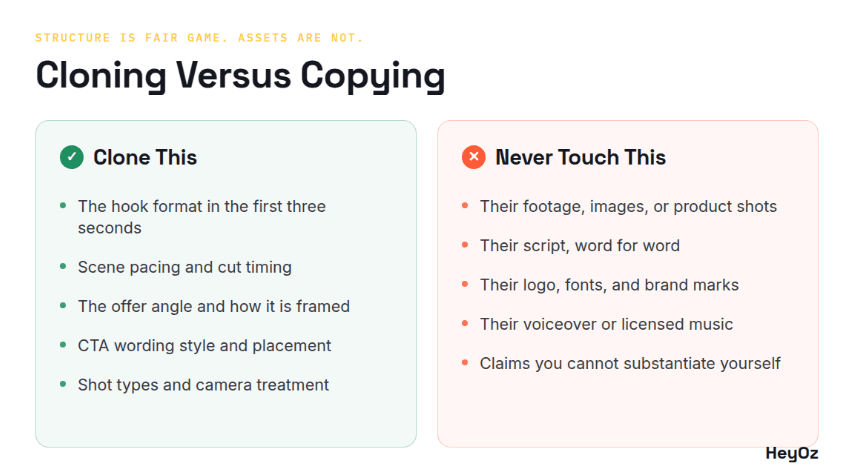
The industry settled on this line for a reason. Structure is fair game. Assets are not.
What you can clone:
- The hook format (question, stat, pattern interrupt, before and after)
- Scene pacing and cut timing
- The offer angle and how it gets framed
- CTA wording style and placement
- Shot types (close up macro, talking head, product in hand)
What you cannot touch:
- Their actual footage or images
- Their script, word for word
- Their logo, fonts, or brand marks
- Their voiceover or licensed music
- Any claim you cannot substantiate about your own product
How to Find Ads Worth Cloning
Most people clone the wrong ads. They pick the one that looks slick instead of the one that is quietly printing money.
Open the Meta Ad Library. Search a competitor by page name. Filter by active ads. Now look at the launch date on each one.
- Age is the signal. An ad running since March is an ad that survived optimization. Meta kills unprofitable creative fast. If it is still live after three months, it works. If a brand is running six near identical variants of the same concept, they found something and they are scaling it.
- Volume is the second signal. When a competitor floods the library with twelve versions of one hook and only one version of everything else, they are telling you exactly where their budget goes.
Then ask yourself the only question that matters: what is the first thing this ad shows, and why did it stop my thumb?
Break the Ad Down Before You Rebuild It
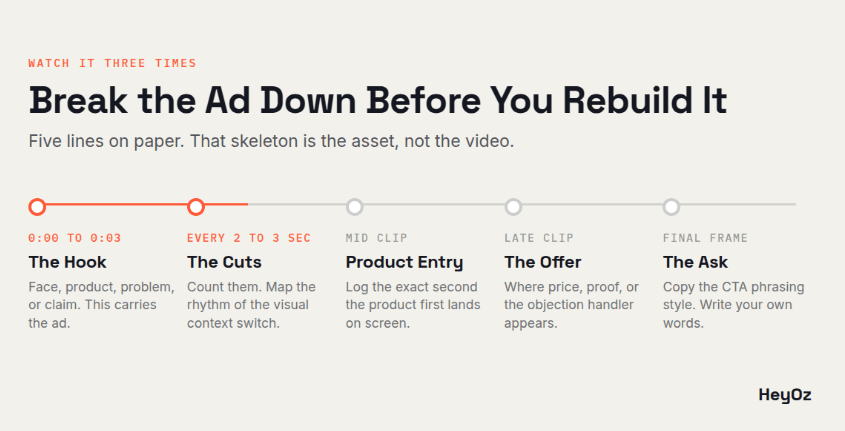
Watch the ad three times. Once for the feeling, once for the timing, once for the words.
Write down what happens in the first three seconds. That is the hook and it carries most of the ad's performance. Note whether it opens on a face, a product, a problem, or a claim.
Then map the cuts. Count them. A high performing TikTok ad usually changes visual context every two to three seconds. A Meta feed ad can breathe a little longer.
Log where the product first appears on screen. Log where the price or offer shows up. Log the exact CTA phrasing.
You now have a skeleton on paper. Five or six lines. That skeleton is the asset, not the video.
Here is where most brands stall. They have the blueprint and no way to build. Booking talent, scheduling a shoot, waiting on an editor. By the time the video is cut, the trend is cold.
Clone Competitor Ads With HeyOz
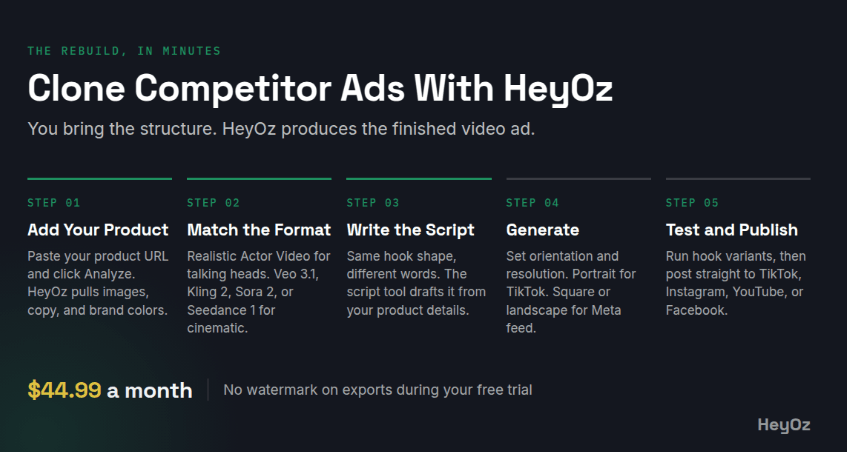
HeyOz was built to close that gap. You bring the structure. It produces the finished video ad.
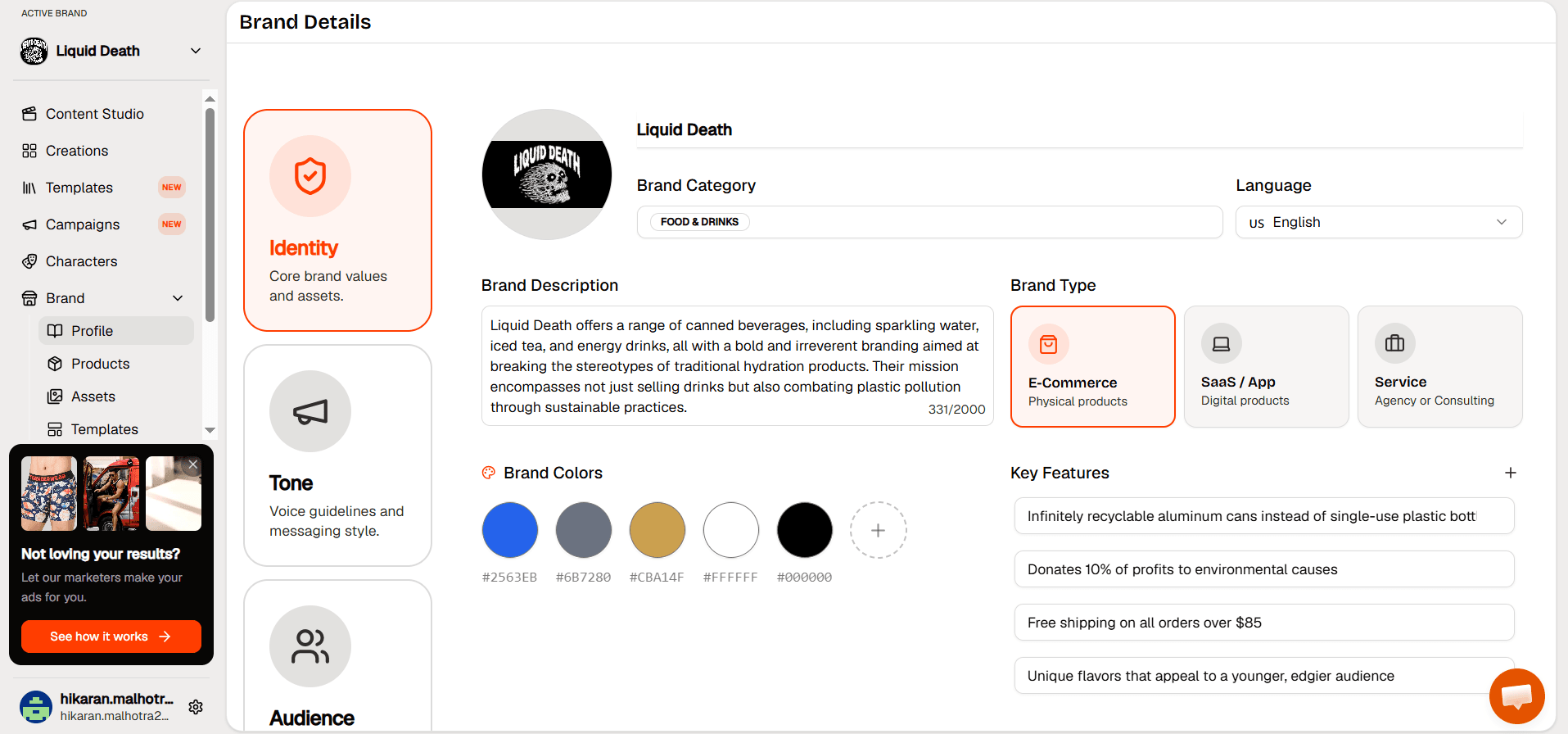
Step 1: Add your product
Open the New Product page and paste your product URL. Click Analyze. HeyOz reads the page and pulls your product images, description, and brand colors automatically. Review what it found and edit anything that looks off.
Step 2: Pick the format that matches the ad you studied
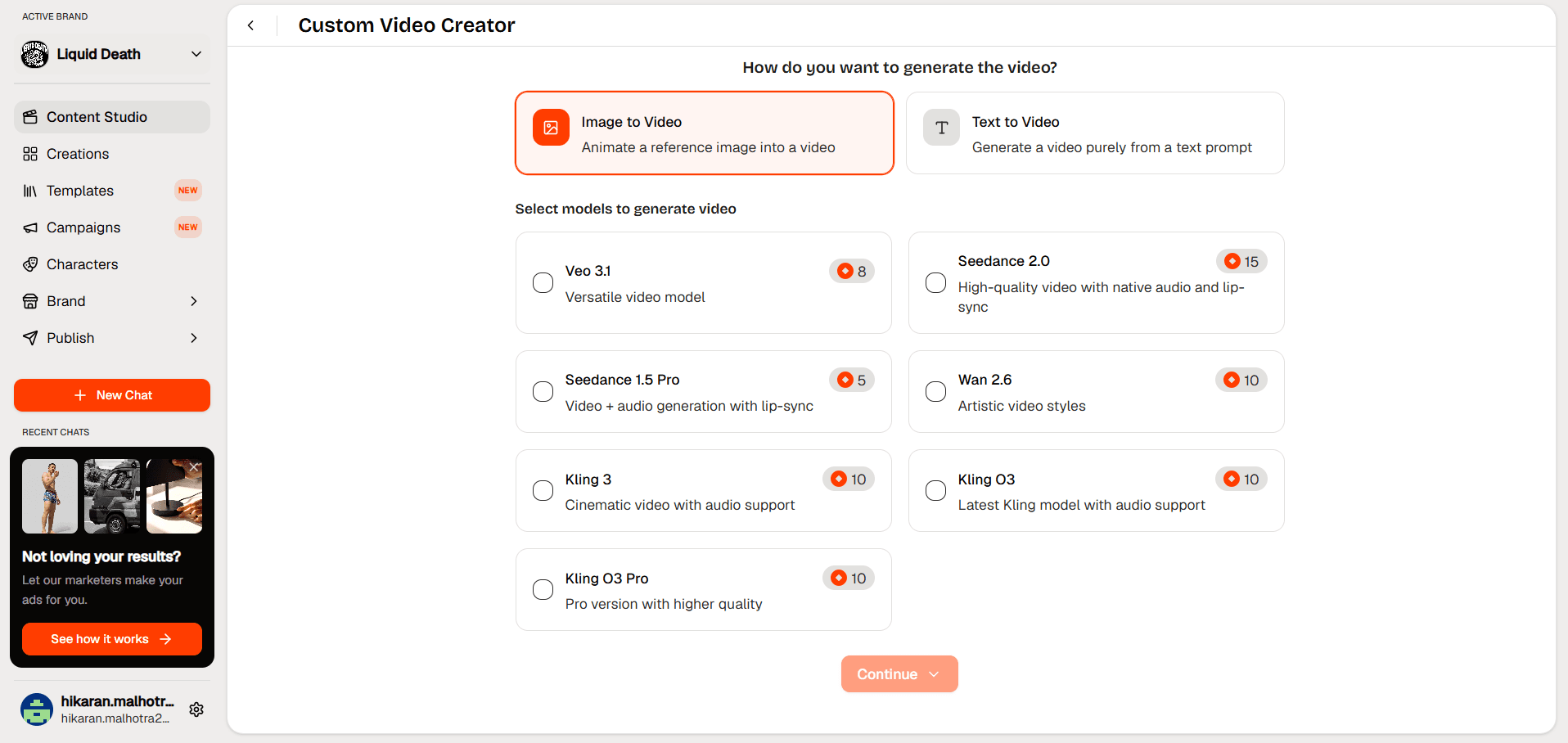
Open the Content Studio and choose your video format. If the ad you mapped was a talking head selling with the product in hand, select Realistic Actor Video. If it was a cinematic product shot, choose a video format and pair it with a model like Veo 3.1, Kling 2, Sora 2, or Seedance 1.
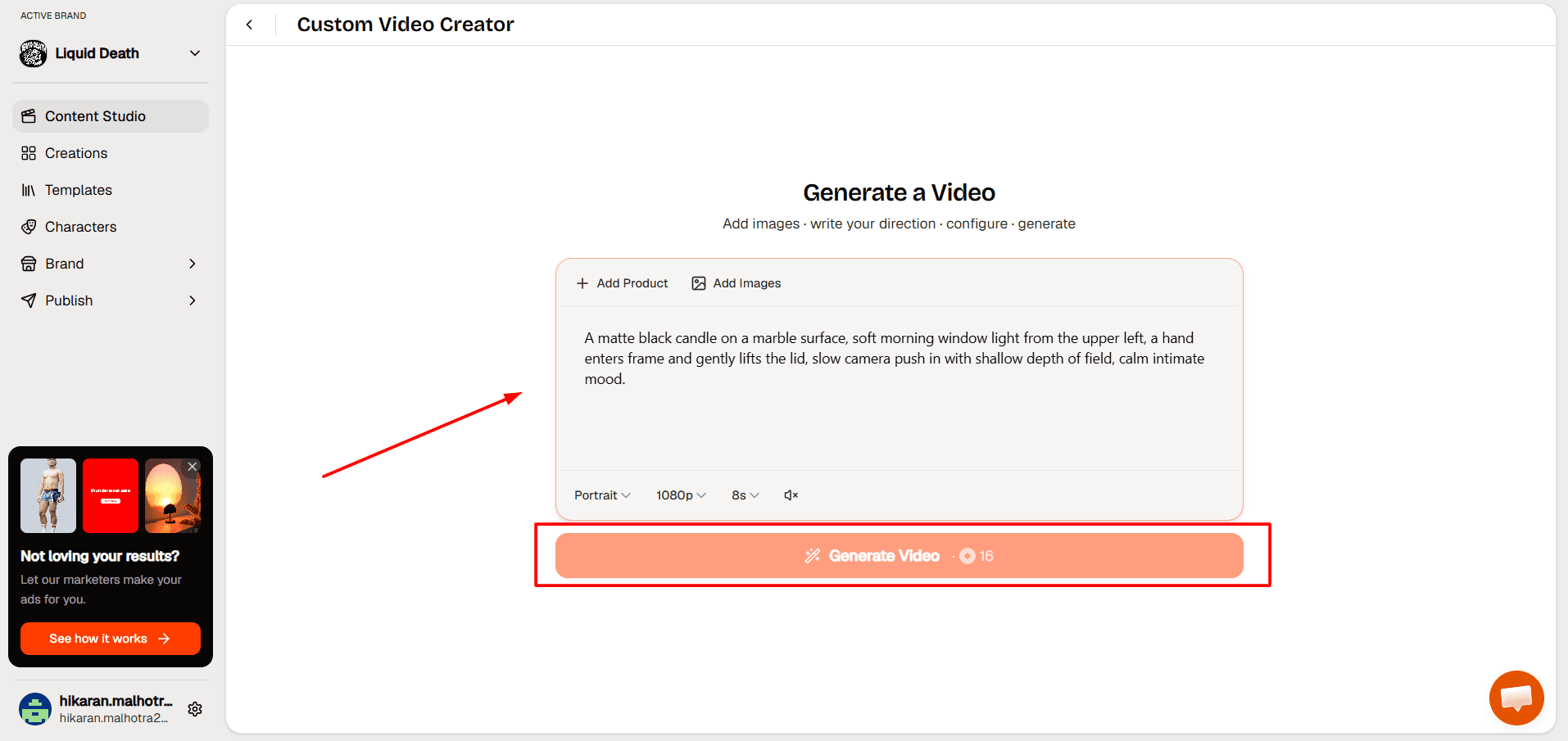
Step 3: Write the script against your skeleton
Use the hook format you logged, but write it for your product. Same shape, different words. The built in script tool will draft it if you describe your product and audience. Keep sentences short.
Step 4: Generate
Set your orientation and resolution. Portrait for TikTok and Reels. Square or landscape for Meta feed. Click Create Videos.
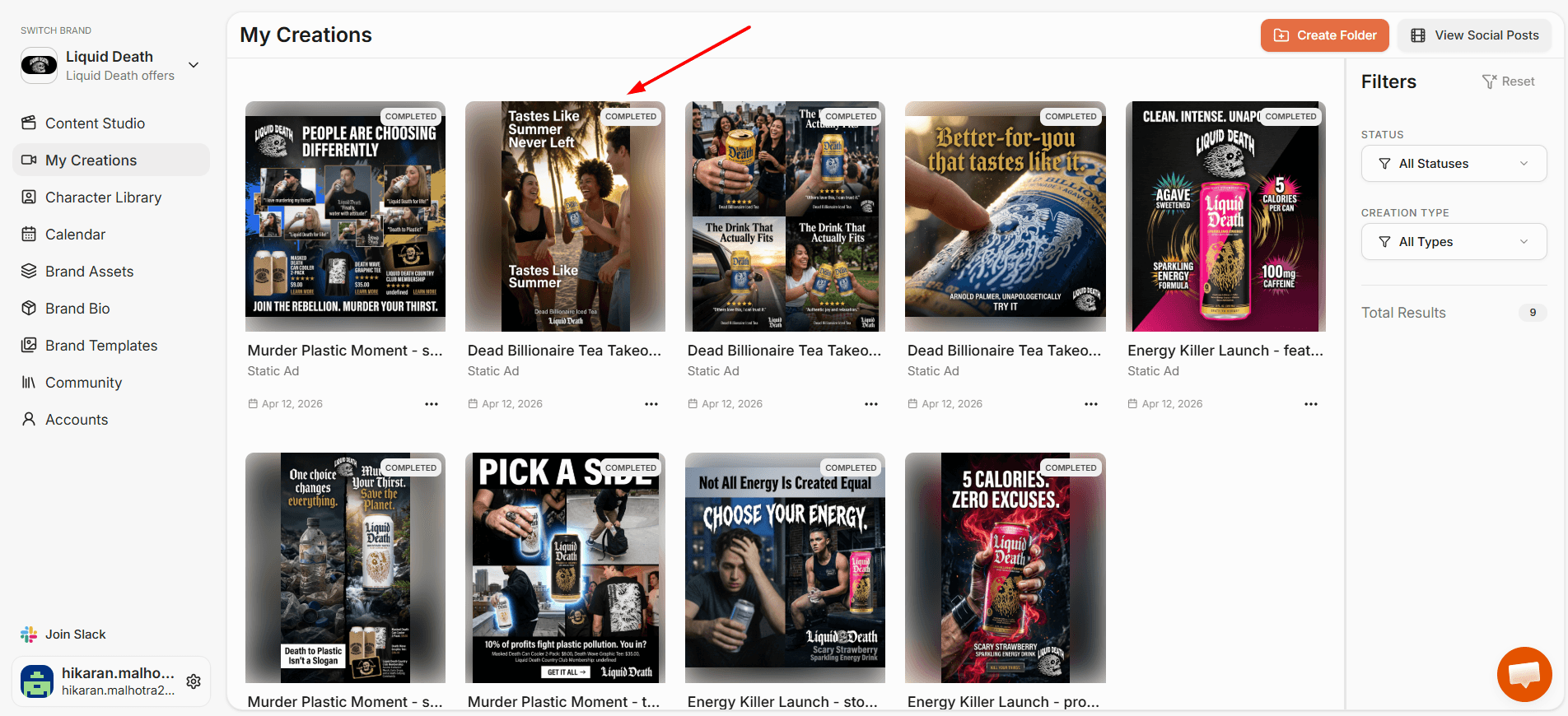
Step 5: Test and publish
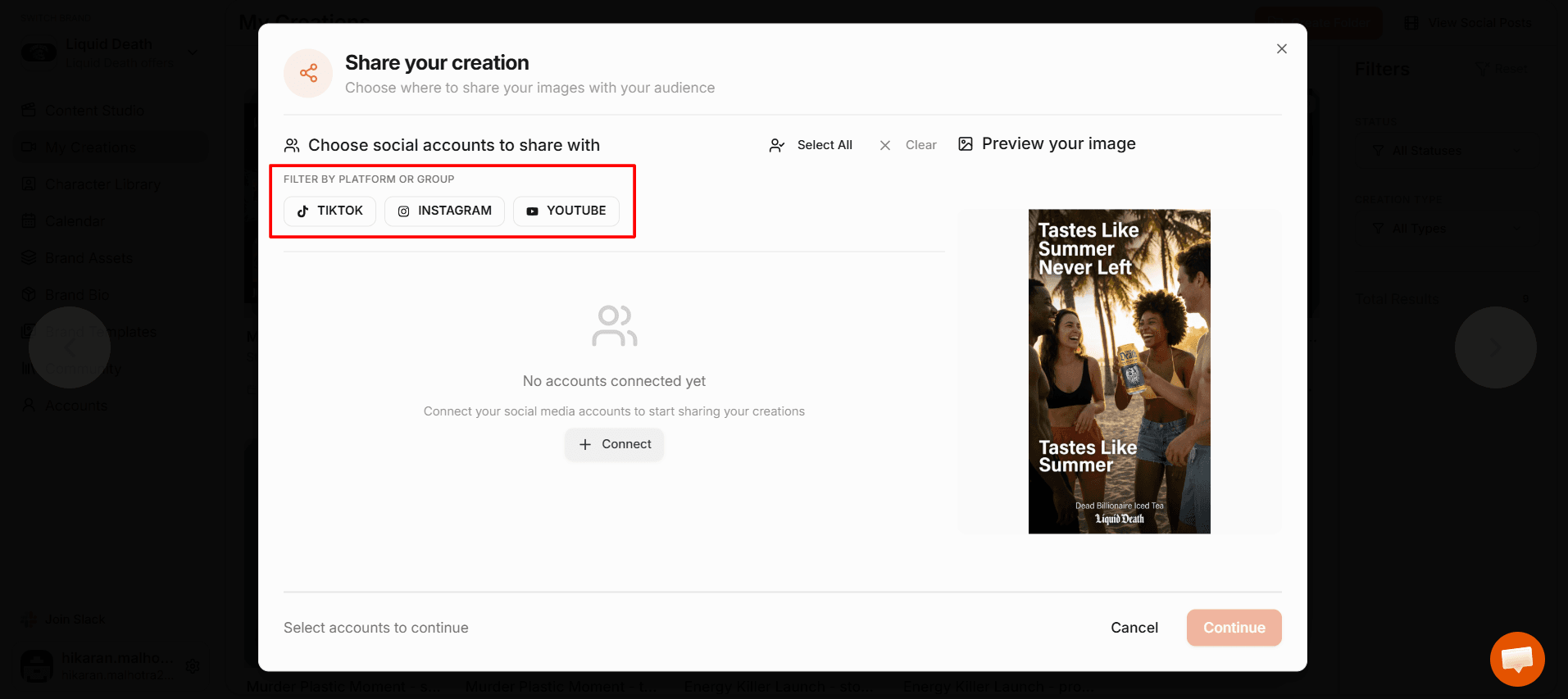
Preview the output, generate two or three variants with different hooks, and publish straight to TikTok, Instagram, YouTube, or Facebook without leaving the platform.
Why Brands Run This Workflow on HeyOz
- AI actors hold, tap, and demonstrate your actual product on camera. Most cloning tools only swap a static image.
- Multiple video models in one place, so you can match the visual style of the ad you are cloning.
- No watermark on exports during the free trial.
- Publishing and scheduling built in, so a cloned ad goes live the same day you find it.
- Flat pricing at $44.99 a month instead of per ad credit fees.
Where Cloning Crosses the Line
Ad formats are not protected. Ad creative is.
Copyright covers fixed creative expression: the footage, the script as written, the music, the images. It does not cover the idea of opening with a problem or cutting to a testimonial at second nine.
Trademark law is separate and stricter. Do not put a competitor's logo, name, or product in your ad. Do not imply endorsement or affiliation that does not exist.
Then there is the FTC. Every claim you make about your product needs substantiation, even if you borrowed the sentence structure from a competitor who apparently had proof. Their evidence does not cover you.
Three checks before you launch:
- Did I produce every frame and every word myself?
- Would a reasonable viewer confuse my ad for theirs?
- Can I back up every claim I made?
If all three answers are clean, launch it.
FAQs
Is it legal to clone competitor ads?
Copying the structure of an ad is legal and common. Copying the actual creative is not. Advertising formats, hook types, and pacing patterns cannot be copyrighted. Footage, scripts, images, and music can be. Recreate the framework with your own assets and you are on solid ground.
How do I find my competitor's ads?
Use the Meta Ad Library, which is free and public. Search by brand page name to see every active ad on Facebook and Instagram. TikTok runs a similar Creative Center. Sort by how long each ad has been live. Longevity is the best free performance signal you have.
How many competitor ads should I clone at once?
Start with three. Pick three different structures rather than three versions of the same one. Run them against your current best performer and let the data pick a winner before you scale.
Can I clone a video ad or only static images?
Both. Tools like AdKit focus on static creative. HeyOz produces full video, including realistic actor footage where a person holds and demonstrates your product on camera.
About the author
Ahad Shams
Ahad Shams is the Founder of HeyOz, an all-in-one ads and content platform built for founders and small teams. He has worked across consumer goods and technology, with experience spanning Fortune 100 companies such as Reckitt Benckiser and Apple. Ahad is a third-time founder; his previous ventures include a WebXR game engine and Moemate, a consumer AI startup that scaled to over 6 million users. HeyOz was born from firsthand experience scaling consumer products and the need for a unified, execution-focused marketing platform.