

The End of the Blue Links: Google Bakes Ads Into AI Answers
Google just moved ads from the edges of the search page into the middle of the answer. At Google Marketing Live on May 20, 2026, the company unveiled a set of ad formats built with its Gemini AI that live inside AI-generated responses. Google says these new ads use Gemini to answer a person's specific question and explain why a product might be right for them. For brands and shoppers, the old rules of search are bending fast.
What Happened?
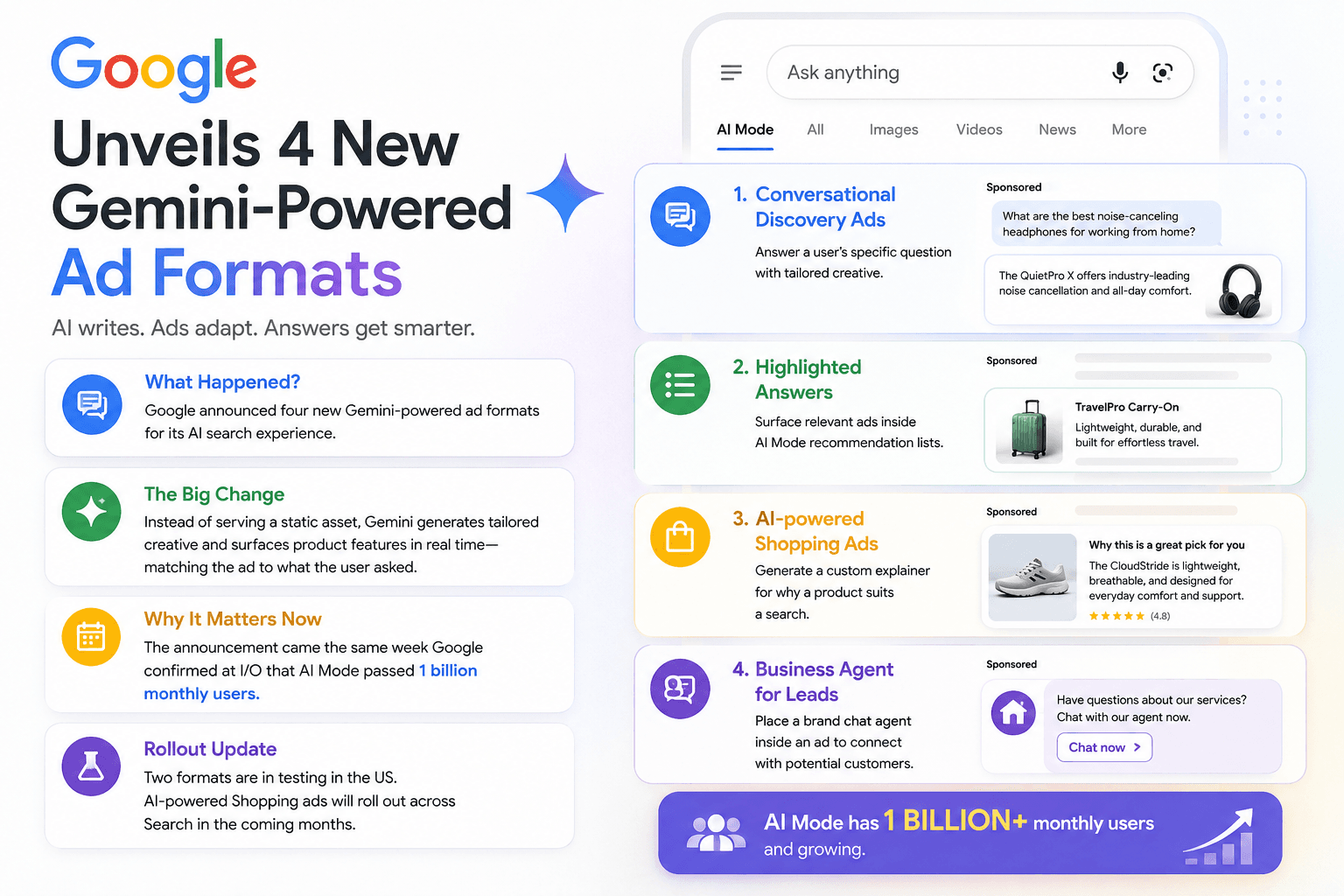
Google announced four new Gemini-powered ad formats for its AI search experience.
The lineup includes Conversational Discovery ads that answer a user's specific question with tailored creative, Highlighted Answers that surface relevant ads inside AI Mode recommendation lists, and AI-powered Shopping ads that generate a custom explainer for why a product suits a search. A fourth tool, Business Agent for Leads, places a brand chat agent inside an ad.
The big change is who writes the ad. Instead of serving a static asset you built in advance, Gemini generates tailored creative and surfaces product features tied to the conversation. So the ad is assembled in real time to match what the person asked.
The timing is not random. The announcement landed the same week Google confirmed at I/O that AI Mode passed 1 billion monthly users. Two of the formats are still in testing in the US, while AI-powered Shopping ads roll out across Search in the coming months.
What's the Impact?
This reaches a massive audience, and that is the first thing to sit with. AI Mode went from zero to 1 billion monthly users in roughly twelve months, which means these mid-answer ad placements are being served to the same order of magnitude of users as Facebook or Instagram. The difference is trust. Unlike those platforms, where users understand they are in an ad-supported space, AI Mode presents itself as an information assistant.
Google's answer to that concern is a context layer. Each ad runs alongside an independent AI explainer that Gemini writes from product information separate from the advertiser's own creative, which Google says adds transparency by making the synthesized reasoning visible. Both parts still carry a Sponsored label.
For brands, the playbook shifts. Because Gemini now generates ad creative per query, structured product data, asset diversity, and landing page quality become the levers that matter, not pre-built creative. Click patterns are already moving too. When the AI summary fully answers a question, fewer sessions move into the research phase and click volume contracts, though the remaining traffic tends to be more qualified.
Google is not alone here. OpenAI confirmed in January 2026 that it would test advertising in ChatGPT, and by May 2026 had opened self-serve cost-per-click ads to US advertisers. The whole industry is racing to put ads inside AI answers at once.
How to Avoid Getting Left Behind
You cannot pay to change the organic AI answer, so the work is making your business the obvious match. A few practical moves:
- Feed Google clean, detailed product data. Gemini builds ads from structured inventory and content, so accurate titles, attributes, and descriptions decide whether you show up.
- Set up AI-friendly campaign types. Google advises setting up campaigns with Performance Max and AI Max tools to take advantage of these features.
- Build content that explains and guides, not just promotes. Ads that educate perform better inside AI-driven results.
- Watch one big calendar change. Google is sunsetting Dynamic Search Ads in September and consolidating that into AI Max, so plan the migration now.
About the author
Ahad Shams
Ahad Shams is the Founder of HeyOz, an all-in-one ads and content platform built for founders and small teams. He has worked across consumer goods and technology, with experience spanning Fortune 100 companies such as Reckitt Benckiser and Apple. Ahad is a third-time founder; his previous ventures include a WebXR game engine and Moemate, a consumer AI startup that scaled to over 6 million users. HeyOz was born from firsthand experience scaling consumer products and the need for a unified, execution-focused marketing platform.