

Key Takeaways
- Product advertising is any paid message designed to promote a specific product to potential buyers, focusing on features, benefits, pricing, and direct calls to action.
- The major types include digital, search, social media, video, display, native, and retail media advertising, each suited to different stages of the buyer journey.
- Short-form video delivers the highest ROI of any content format, with .
- Retail media networks are delivering and nearly 3x better results for purchase intent.
- AI-powered creative tools now produce studio-quality ad assets in minutes, fundamentally changing the economics of product advertising.
- First-party data has become a non-negotiable foundation for effective advertising as privacy regulations tighten and third-party cookies continue to be deprecated.
- The most effective product advertising strategies in 2026 combine multiple formats across platforms, driven by AI optimization and data-driven creative.
What Is Product Advertising?
Product advertising is paid promotion focused on a specific product rather than a brand's overall identity. Its purpose is to drive awareness, consideration, and purchase of a particular item by highlighting what the product does, why it matters, and how to buy it.
This differs from brand advertising, which builds long-term perception and emotional connection without promoting a specific product. Product advertising is direct. It shows the item, explains the value, and asks for the sale.
Product advertising spans every channel: digital platforms, search engines, social media, television, out-of-home, print, and retail environments. In 2026, digital channels dominate, but the most effective strategies use multiple touchpoints to reach buyers wherever they spend time.
The global digital advertising market continues to expand. Brands are spending more on product-specific campaigns because they are measurable, targetable, and directly tied to revenue outcomes.
What Are the Main Types of Product Advertising?
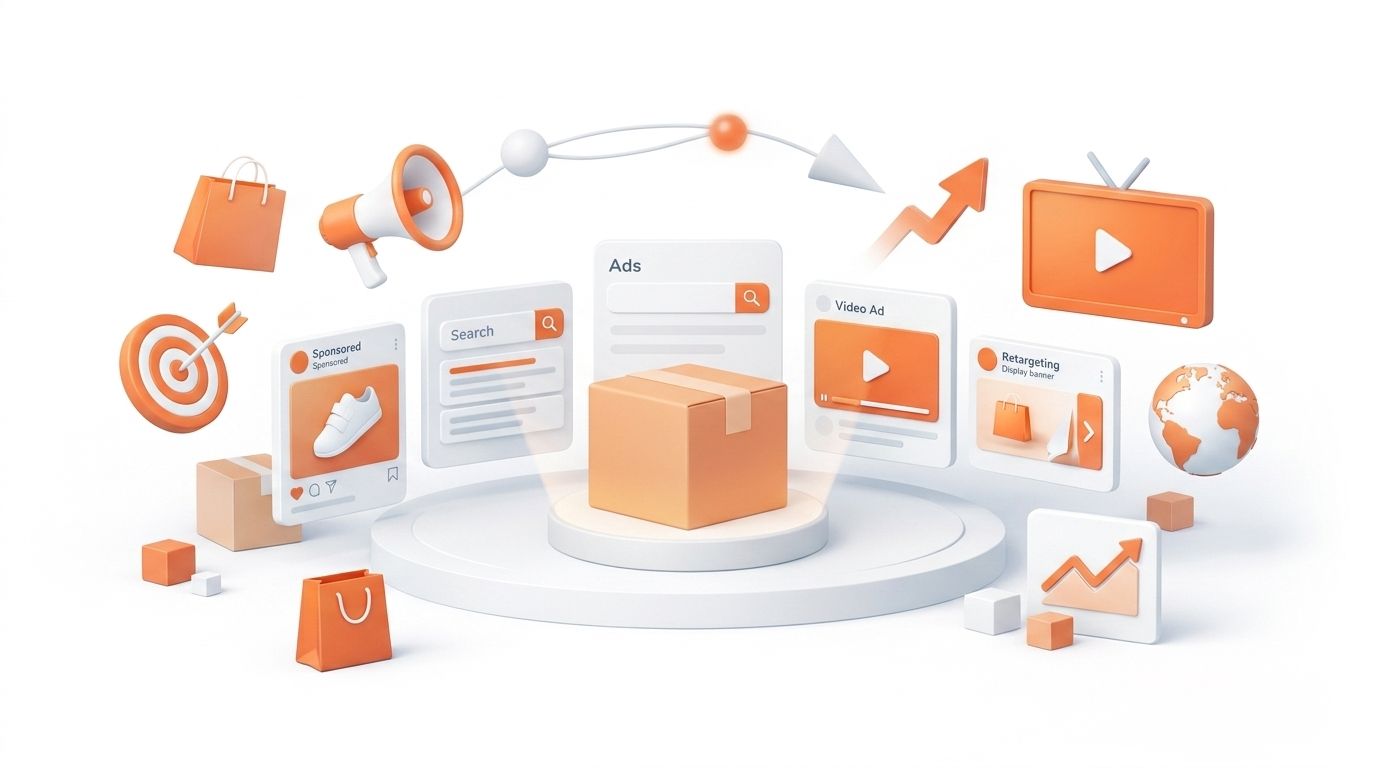
Product advertising breaks into several distinct categories, each with different strengths, costs, and use cases.
Search advertising. Paid ads within search engine results triggered by specific keywords. When someone searches "best running shoes," search ads place your product at the top of results. This captures high-intent buyers actively looking for solutions. Google Ads remains the dominant platform, with average CPCs varying by industry from $0.50 to $5.00+.
Social media advertising. Paid ads on platforms like Facebook, Instagram, TikTok, and LinkedIn. Social ads excel at visual product presentation and reaching audiences based on interests, behaviors, and demographics. Short-form video delivers the highest ROI of any content format on social platforms.
Display advertising. Banner ads, image ads, and rich media placements across websites and apps. Display works best for brand awareness and retargeting. Programmatic buying automates placement and optimization across thousands of sites.
Video advertising. Pre-roll, mid-roll, and standalone video ads on YouTube, streaming platforms, and social media. Video demonstrates products more effectively than static formats and drives higher engagement. 74% of Facebook advertisers cite video as their top-performing format.
Native advertising. Ads that match the look and feel of the editorial content surrounding them. Native ads appear in news feeds, recommendation widgets, and content platforms. They reduce ad resistance by blending with organic content.
Retail media advertising. Ads placed within retail environments, both online (Amazon Sponsored Products, Walmart Connect) and in-store (digital screens, end-cap displays). Retail media networks deliver 1.8x better results than standard digital ads and nearly 3x better results for purchase intent because they reach shoppers at the point of purchase.
Pioneering advertising. Used to introduce entirely new products or categories. The goal is education, not persuasion. Effective for innovative products where consumers do not yet understand the category.
What Is New in Product Advertising for 2026?
Several developments are reshaping how brands advertise products this year.
AI-powered creative production. Tools like Google Ads Asset Studio and third-party AI platforms produce studio-quality ad creative in minutes. This is not a marginal improvement. It fundamentally changes the economics of product advertising by enabling high-volume creative testing at a fraction of traditional production costs. HeyOz Creative Advertising Agency leverages AI creative production to deliver scalable, performance-driven product advertising across platforms.
Agentic commerce. AI-powered shopping assistants are transforming how consumers discover and purchase products. These agents evaluate options, compare prices, and make purchase recommendations on behalf of users. Brands need to optimize their product advertising for AI-mediated discovery, not just human browsing.
First-party data strategies. With third-party cookies continuing to be deprecated, brands are investing in first-party data collection through loyalty programs, email lists, and direct customer relationships. Product advertising effectiveness increasingly depends on owned data quality.
Retail media growth. Retail media networks (Amazon, Walmart, Target, Instacart) are capturing an increasing share of product advertising budgets. Their advantage is proximity to the purchase decision. Shoppers seeing ads while actively browsing product categories convert at significantly higher rates.
Short-form video dominance. Short-form video on TikTok, Instagram Reels, and YouTube Shorts is the highest-ROI format for product advertising. 48.6% of marketers rank it first for content ROI, driven by high engagement rates and viral potential.
Privacy-compliant targeting. New targeting approaches that respect user privacy while maintaining effectiveness are emerging. Contextual targeting, cohort-based advertising, and AI-modeled audiences are replacing individual-level tracking.
How Do You Choose the Right Product Advertising Strategy?
Selecting the right approach depends on your product, audience, and business goals.
For new product launches: Combine pioneering advertising with social media and video to educate the market. Focus on explaining what the product does and why it matters.
For ecommerce products: Prioritize retail media (if selling on Amazon or Walmart), social media advertising with strong product visuals, and search advertising to capture demand. Retarget website visitors with display and video ads.
For high-consideration products: Use search advertising to capture intent, video advertising to demonstrate value, and native content to build trust through education. These products need multiple touchpoints before purchase.
For impulse-purchase products: Social media and short-form video excel at driving immediate action. Use strong visual hooks, limited-time offers, and seamless purchase paths.
For B2B products: LinkedIn advertising, search advertising, and native content perform best. Focus on lead generation rather than direct purchase, with educational content that addresses business pain points.
How Do You Measure Product Advertising Effectiveness?
Track these metrics to evaluate whether your product advertising delivers results.
Awareness metrics. Reach, impressions, video view rate, and brand lift. These measure whether your target audience is seeing your product advertising.
Engagement metrics. Click-through rate, video completion rate, and social engagement. These indicate whether your creative resonates with the audience.
Conversion metrics. Cost per acquisition, conversion rate, and return on ad spend. These are the bottom-line metrics that determine profitability.
Attribution metrics. Multi-touch attribution, incrementality testing, and media mix modeling. These help you understand which channels and touchpoints drive the most value across the customer journey.
Creative metrics. Hook rate, thumb-stop rate, and creative fatigue indicators. These evaluate the performance of individual ad assets and inform creative production decisions.
Establish baseline performance for each channel, then test and iterate. The brands that win at product advertising are those that measure rigorously and optimize continuously.
Frequently Asked Questions
What is the difference between product advertising and brand advertising?
Product advertising promotes a specific item with the goal of driving sales. Brand advertising builds overall brand perception and emotional connection without focusing on a particular product. Most effective marketing strategies include both, with product advertising driving short-term revenue and brand advertising building long-term equity.
Which product advertising channel has the best ROI?
It depends on your product and audience. For ecommerce, retail media networks and social media video ads deliver the strongest ROI. For B2B, search advertising and LinkedIn typically perform best. Short-form video across platforms is currently the highest-ROI content format overall.
How much should I budget for product advertising?
A common framework is allocating 5-15% of target revenue to advertising. New products or brands entering competitive markets may need to invest 15-25% initially. Start with test budgets of $3,000-$5,000/month per channel and scale based on performance data.
Is AI replacing traditional product advertising?
AI is not replacing product advertising. It is transforming how it is produced and optimized. AI-powered tools generate creative faster and cheaper, optimize targeting and bidding in real time, and analyze performance data at scale. Human strategy and creative direction remain essential.
How do I advertise a product with a small budget?
Focus on one or two channels where your audience is most concentrated. Social media advertising and search advertising offer the lowest entry barriers. Use AI creative tools to produce ad assets affordably. Start with $1,000-$2,000/month and reinvest returns into scaling what works.
About the author
Ahad Shams
Ahad Shams is the Founder of HeyOz, an all-in-one ads and content platform built for founders and small teams. He has worked across consumer goods and technology, with experience spanning Fortune 100 companies such as Reckitt Benckiser and Apple. Ahad is a third-time founder; his previous ventures include a WebXR game engine and Moemate, a consumer AI startup that scaled to over 6 million users. HeyOz was born from firsthand experience scaling consumer products and the need for a unified, execution-focused marketing platform.