

Key Takeaways
- AI ads full funnel marketing enables brands to create distinct creatives for awareness, consideration, conversion, and retention
- Different funnel stages require different messages, formats, and creative styles
- AI makes it practical to test and iterate on stage-specific ads at scale
- Performance improves when creatives align with audience intent at each stage
- Platforms like Heyoz help brands manage full-funnel ad creation from a single system
Introduction
Most brands don’t struggle because of poor targeting or weak products. They struggle because they reuse the same ad everywhere. A creative designed to introduce a brand is often shown to someone ready to buy. A conversion-focused ad is shown to people who don’t yet understand the problem it solves. This mismatch wastes budget and reduces performance across the funnel.
Full-funnel advertising addresses this issue by aligning creatives with where the audience is in their decision-making journey. Awareness, consideration, conversion, and retention are not just media stages; they represent different mindsets. Each stage requires different messaging, formats, and creative goals.
Historically, full-funnel execution was difficult to maintain. Creating multiple versions of ads for each stage required more time, larger teams, and higher costs. As a result, many brands simplified their approach and reused creatives, sacrificing relevance for convenience.
AI changes this equation. By automating creative generation and variation, AI makes it possible to produce stage-specific ads without multiplying effort. This article explains how AI ads full funnel marketing works, what types of ads perform best at each stage, and how brands can use AI to run cohesive, high-performing campaigns across the entire funnel.
What Full-Funnel Advertising Means in Modern Marketing
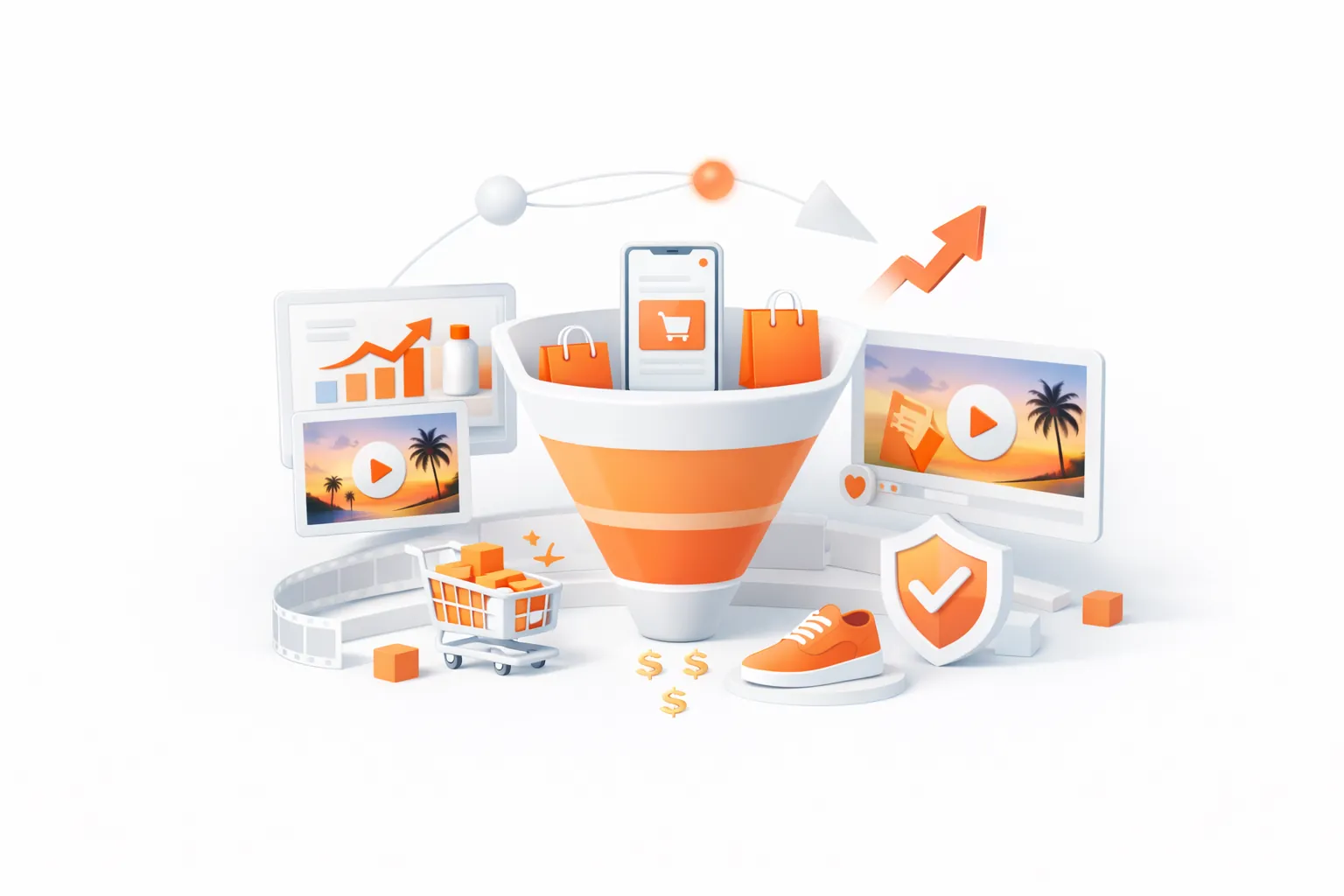
Full-funnel advertising is a strategy that aligns creative messaging with each stage of the customer journey rather than treating all audiences the same.
The four funnel stages
- Awareness: Introducing the problem or brand to new audiences
- Consideration: Educating and helping audiences evaluate options
- Conversion: Driving action through clear offers and trust signals
- Retention: Encouraging repeat purchases and long-term engagement
Why are different messages required
Someone discovering a brand for the first time needs context, not urgency. Someone comparing options needs clarity and proof. Someone ready to buy needs reassurance and a clear call to action. Reusing the same ad ignores these differences and lowers relevance.
How a full-funnel strategy improves performance
When creatives align with intent:
- Engagement increases at the top of the funnel
- Consideration audiences move forward more efficiently
- Conversion rates improve due to reduced friction
- Retention campaigns feel helpful rather than promotional
AI makes this approach achievable at scale by reducing the cost and time required to create distinct creatives for each stage.
How AI Supports Top-of-Funnel Awareness Ads
Awareness ads are designed to capture attention and introduce a problem or brand, not to sell immediately.
Effective formats for awareness
AI performs well at generating:
- Short-form vertical videos
- and trend-driven creatives
- Educational or curiosity-based ads
- Broad lifestyle or problem-framing content
These formats feel native to social feeds and are optimized for fast scrolling behavior.
Messaging strategy
Top-of-funnel messaging should:
- Focus on problems, not products
- Use simple language and relatable scenarios
- Avoid aggressive calls to action
- Spark interest rather than demand commitment
AI enables rapid experimentation with hooks and tones, making it easier to find messages that resonate with broad audiences.
Measuring success
Awareness campaigns are measured by:
- Reach and impressions
- Engagement rates
- Video watch time
- Audience growth
AI allows brands to test multiple creative concepts quickly, improving the chances of identifying strong entry points into the funnel.
How AI Supports Mid-Funnel Consideration Ads
Consideration ads help audiences evaluate whether a product or brand is right for them.
Effective formats for consideration
AI excels at producing:
- Product demos and explainers
- Feature-focused videos
- Comparison and contrast creatives
- Social proof and review-style content
These formats provide clarity and reduce uncertainty.
Messaging strategy
Mid-funnel messaging should:
- Explain how the product works
- Highlight key benefits and differentiators
- Address common questions or objections
- Build trust without forcing urgency
AI can generate multiple explanatory angles, allowing brands to test which benefits matter most to engaged audiences.
Retargeting engaged users
AI makes it easy to tailor consideration ads for users who:
- Watched awareness videos
- Clicked but didn’t convert
- Engaged with previous content
This personalization improves relevance and efficiency.
How AI Supports Bottom-Funnel Conversion Ads
Conversion ads are designed to drive action. At this stage, clarity and trust matter more than creativity.
Effective formats for conversion
AI supports:
- UGC-style testimonials and reactions
- explainers focused on offers
- Objection-handling creatives
- Limited-time or incentive-based messaging
These formats help reduce hesitation and reinforce credibility.
Messaging strategy
Bottom-funnel messaging should:
- Clearly communicate the offer
- Emphasize outcomes and proof
- Address final objections
- Include a direct call to action
AI allows brands to test variations of offers, messaging, and CTAs quickly, optimizing for conversion without rebuilding campaigns manually.
How AI Supports Retention and Repeat Purchase Ads
Retention ads focus on customers who have already converted.
Effective formats for retention
AI helps generate:
- Upsell and cross-sell creatives
- New feature or product announcements
- Educational usage content
- Loyalty and community-focused ads
These creatives feel more like value-add content than traditional advertising.
Messaging strategy
Retention messaging should:
- Reinforce value after purchase
- Encourage deeper product usage
- Introduce complementary products
- Reward loyalty rather than push sales
AI enables consistent communication with existing customers without overwhelming internal teams.
Why AI Makes Full-Funnel Creative Testing Scalable
Testing is critical to full-funnel success, but manual testing is resource-intensive.
Creating multiple variants per stage
AI can generate multiple creatives for each funnel stage, allowing teams to test:
- Different hooks for awareness
- Different explanations under consideration
- Different offers at conversion
- Different messages for retention
Learning faster from performance data
More variants lead to faster insights about what works at each stage.
Reducing creative fatigue
Rotating creatives prevents audiences from seeing the same message repeatedly.
Iterating without rebuilding campaigns
AI allows teams to refine creatives without restarting entire workflows, saving time and budget.
Common Mistakes Brands Make with AI Full-Funnel Ads
Using the same creative everywhere
This defeats the purpose of a full-funnel strategy and reduces relevance.
Ignoring audience intent
Even well-designed ads fail when shown to the wrong audience stage.
Optimizing only for clicks
Clicks alone don’t indicate funnel progress. Metrics should align with stage goals.
Scaling before validating messaging
AI makes scaling easy, but scaling unproven creatives magnifies inefficiencies.
Avoiding these mistakes ensures AI enhances strategy rather than replacing it.
How Heyoz Helps Brands Run AI-Generated Ads Across the Funnel
Heyoz is built to support AI ads full funnel marketing through structured creative execution.
- Step 1: Choose an AI actor video ad format
Select an AI actor or video ad format to create a talking-head or presenter-style video .
📸 Screenshot: Video / AI actor format selection screen
- Step 2: Add your script or prompt
Provide a script or short prompt describing what the AI actor should say and how the ad should feel.
📸 Screenshot: Script or prompt input + actor preview
- Step 3: Generate and review the video ad
Generate the video and review the output. You can regenerate variations, make edits, or export the final video for use in ads.
📸 Screenshot: AI actor video preview screen
By centralizing creative production and variation, Heyoz allows brands to maintain consistency while tailoring ads to funnel intent. This makes full-funnel execution practical without increasing operational complexity.
Conclusion
AI-generated ads are most powerful when applied intentionally across the entire funnel. By matching creative formats and messages to audience intent, brands can improve efficiency, performance, and customer lifetime value.
AI ads full funnel marketing is not about producing more ads; it’s about producing the right ads at the right time. Platforms like Heyoz make this approach scalable, allowing teams to move faster while staying aligned with strategic goals.
Frequently Asked Questions
1. Can AI-generated ads be used at every funnel stage?
Yes, AI can produce awareness, consideration, conversion, and retention creatives.
2. What type of AI ads work best at the top of the funnel?
Short-form video, meme-style, and educational creatives perform well for awareness.
3. How does AI help with mid-funnel ads?
AI enables fast testing of demos, explanations, and social proof formats.
4. Are AI ads effective for conversions?
Yes, especially when used for UGC-style testimonials and clear offers.
5. Which platform supports full-funnel AI ad creation?
Platforms like Heyoz help brands create and manage AI ads across all funnel stages.
About the author

Ahad Shams
Ahad Shams is the Founder of HeyOz, an all-in-one ads and content platform built for founders and small teams. He has worked across consumer goods and technology, with experience spanning Fortune 100 companies such as Reckitt Benckiser and Apple. Ahad is a third-time founder; his previous ventures include a WebXR game engine and Moemate, a consumer AI startup that scaled to over 6 million users. HeyOz was born from firsthand experience scaling consumer products and the need for a unified, execution-focused marketing platform.