

Key Takeaways
- Most Meta ads die from copy fatigue, not creative fatigue. Running 1 copy variant against thousands of impressions is a slow death. These 4 free Claude skills generate 50+ on-brand copy variants per product in about 20 minutes.
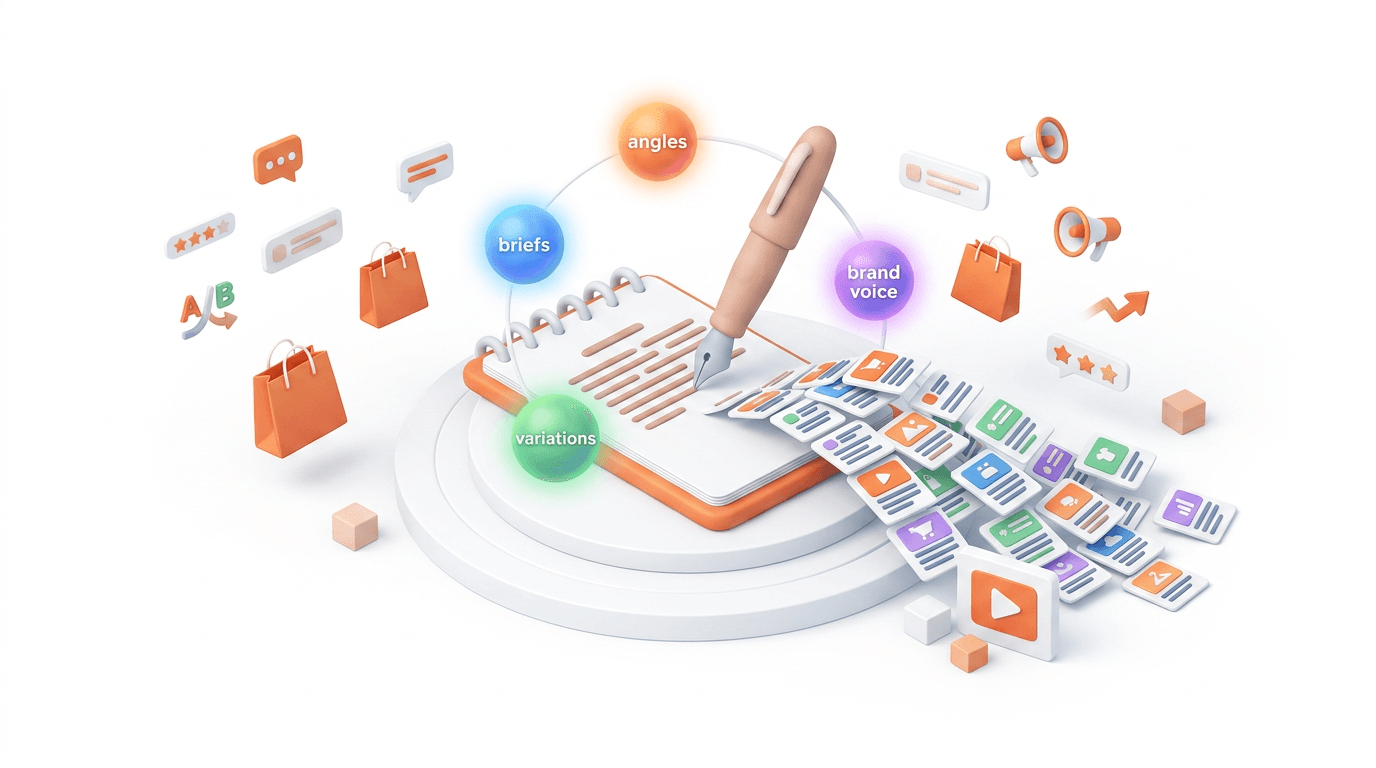
- The 4-skill pipeline: Ad Angle Generator (30 angles across 6 hook categories), Creative Brief Writer (full production briefs), Copy Variations Generator (10 primary texts + 15 headlines + 10 descriptions + 5 CTAs per brief), and Brand Voice Locker (extracts and enforces your brand voice).
- Everything runs on claude.ai in your browser using Claude Projects. No coding, no API keys, no terminal commands. Upload the free skill files as project knowledge and start chatting.
- Total cost: $20/month (Claude Pro). Compare to $500-2,000 per round with a freelance copywriter or $2,000-5,000/month with an agency for copy production.
- The workflow compounds over time. Feed winners from each testing round back into the skills, and every new batch is informed by real performance data instead of guesses.
Introduction
Most Meta ads die from copy fatigue, not creative fatigue. A brand finds a winning visual. Runs it with the same headline and primary text for weeks. CTR dies. They blame the creative. It was not the creative. It was running 1 copy variant against thousands of impressions.
Meta's algorithm needs ammo — different angles, different hooks, different emotional triggers — to find what resonates with each audience segment. These 4 free Claude skills generate that ammo. Paste your product context once, get 50+ on-brand copy variants in about 20 minutes.
No coding. No API keys. Everything runs on claude.ai in your browser through Claude Projects.
What Do These 4 Skills Do?
Each skill handles one step in the copy production pipeline. They chain together: the output of one feeds the next.
Skill 1: Ad Angle Generator.
Paste your product context (URL, brief, or description). Returns 30 distinct angles across 6 hook categories: problem-aware, benefit-led, social proof, direct offer, curiosity, and comparison. Each angle includes the audience pain it targets and the emotional driver behind it. Your strategist in a markdown file.
Skill 2: Creative Brief Writer.
Pick any angle from Skill 1. Returns a full production brief: hook, core message, visual direction, CTA, tone, target audience, and success metric. Ready to hand to a designer, UGC creator, or AI generator. No more half-baked Slack messages as briefs.
Skill 3: Copy Variations Generator.
Pick a brief from Skill 2. Returns: 10 primary text variations (short, medium, long form), 15 headlines under 40 characters, 10 descriptions under 30 characters, and 5 CTAs matched to the angle. All Meta-spec compliant. All testable in one ad set.
Skill 4: Brand Voice Locker.
Drop in 5-10 of your best-performing past ads. Extracts your brand voice rules: sentence length patterns, vocabulary, banned phrases, required elements, tone markers. Enforces them across Skills 1-3. Your AI-generated copy stops sounding like AI.
The full workflow: Skill 4 learns your voice (one-time), Skill 1 generates 30 angles per product, Skill 2 turns the top 5 into briefs, Skill 3 expands each brief into 30+ copy variations. You pick the strongest 10-15 and launch. That is 50+ on-brand variants per product in about 20 minutes.
What Do You Need to Get Started?
- Claude Pro ($20/month) — sign up at claude.ai. The Free plan works but has lower message limits.
- The 4 skill files (.md files) — available free, request via the LinkedIn post or download from the links provided
- A browser — everything runs on claude.ai, no software to install
- A Meta Ads Manager account — for launching the finished copy variants
- 5-10 of your past best-performing ads — needed for Skill 4 (brand voice extraction). If you do not have these yet, use competitor ads or your website/email copy as a starting point.
No Claude Code installation. No terminal commands. No API keys.
How Do You Set Up Your Claude Project?
Claude Projects lets you give Claude persistent context — files it remembers across every conversation. Upload the skill files once, and Claude uses them in every chat without you needing to paste them again.
Go to claude.ai and log in. Click Projects in the left sidebar. Click New Project in the upper right. Name it something like Meta Ad Copy Generator and click Create. Inside your project, find the knowledge section on the right side. Click the + button, select Upload files, and upload all 4 skill .md files. Optionally, click Set project instructions and add guidance telling Claude which skill to use for each request.
Claude Projects supports up to 200K tokens of knowledge (about 500 pages of text), with automatic RAG expansion on Pro plans for even more. The 4 skill files are small and well within limits.
How Do You Lock Your Brand Voice?
This is the most important step and you only do it once. Skill 4 extracts your brand DNA from your actual best-performing ads.
Start a new chat in your project and paste 5-10 of your best ads (headline, primary text, and description for each). Ask Claude to extract your brand voice rules. Claude returns: sentence length patterns, vocabulary fingerprint (words you repeat across winners), banned phrases (AI filler your brand never uses), required elements (stats, questions, specific CTA formats), tone markers, and formatting patterns.
Save the output by copying the Brand Voice Document and adding it to your project knowledge. Click the + in the knowledge section and paste it as text. Now every future chat in this project automatically applies your voice. Test by asking Claude to write a sample headline — if it sounds like your brand, the lock is working.
If you do not have 5 winning ads yet, use competitor ads you admire plus any copy from your website, emails, or social posts. Re-run Skill 4 later with your own winners.
How Do You Generate 30 Angles for Your Product?
Start a new chat and give Claude your product context: name, URL, price, key benefits, target audience, and main competitor. The more specific the input, the better the angles.
Claude returns 30 angles across 6 categories (5 per category). Problem-Aware angles lead with pain points for cold audiences. Benefit-Led angles lead with outcomes for people who know the category. Social Proof angles lead with credibility for skeptical audiences. Direct Offer angles lead with price or deals for warm audiences. Curiosity angles create information gaps that drive high CTR. Comparison angles position against alternatives for crowded categories.
To filter: ask Claude to score each angle 1-10 on hook strength, brand fit, and audience relevance, then flag the top 5. These go into the next step.
Pro tip: before generating angles, paste 5-10 real customer reviews from your product page. Tell Claude to use the exact words and pain points from these reviews. Real customer language produces higher-converting copy than polished marketing speak.
How Do You Turn Angles Into Briefs and Copy Variations?
Briefs (Skill 2):
For each top angle, ask Claude to write a full creative brief. Each brief contains: hook, core message, visual direction, CTA, tone, target audience, success metric, and A/B test note. These briefs are ready to hand directly to a designer, UGC creator, or AI creative tool. Do not skip this step — it forces strategic clarity about the one message each ad communicates.
Copy Variations (Skill 3):
For each brief, ask Claude to generate the full copy testing matrix. You get: 10 primary text variations (3 short under 50 words, 4 medium 50-100 words, 3 long 100-150 words), 15 headlines all under 40 characters (mix of questions, statements, and number-driven), 10 descriptions all under 30 characters, and 5 CTAs matched to the angle type.
Multiply across 5 briefs: 150+ individual copy pieces. Pick the strongest 10-15 combinations for launch. That is more copy to test than most brands produce in a quarter.
How Do You Launch and Test in Meta Ads Manager?
Pick your 1-3 best-performing visuals (images or videos with proven engagement). Pair each visual with 10 different headline + primary text + CTA combinations. Launch all 10 as individual ads within one ad set at $5-10 per ad per day.
After 3-4 days, analyze: kill anything with CTR below 1% and no conversions, keep running above-average performers, scale winners by increasing budget or duplicating into new ad sets.
The math: 1 winning visual multiplied by 50 copy variations equals 50 chances to find the angle Meta favors today. 1 winning visual multiplied by 1 copy variant equals the slow death your last ad suffered.
Meta ad copy specs to verify: Primary text recommended under 125 characters (truncates beyond this on most placements). Headlines under 40 characters. Descriptions under 30 characters. Avoid ALL CAPS across entire text, excessive emoji, and before/after claims without disclaimers.
How Do You Iterate on Winners?
After each round of testing, feed your winners back into the skills. Start a new chat, paste your top 3 performing headlines with their CTR, CPA, and ROAS data, and ask Claude to generate 20 new variations building on those winning patterns.
Each cycle gets smarter because your input data improves. By round 3-4, your copy variants are informed by actual performance data, not guesses. Update your brand voice lock every 60 days with your latest winners to keep the voice rules fresh.
Run this workflow every 2-3 weeks per product, or whenever CTR starts declining on current ads.
What Are the Best Tips for Better Results?
Give Claude specific product details. Generic product descriptions produce generic angles. Include specific numbers: price, star rating, customer count, key specs, comparison to competitors.
Feed in real customer language. Paste 5-10 actual reviews before generating angles. Real buyer language converts better than polished marketing speak.
Test across hook categories, not just within. Your biggest insight will be discovering which category (curiosity vs benefit-led vs social proof) works best for your product, not which specific headline variation wins.
Do not skip the brief step. Going straight from angles to copy variations produces 50 versions of mush. Briefs force strategic clarity about the one message each ad communicates.
Use the description field. Most advertisers leave it blank. Meta shows descriptions on some placements. A strong 30-character description can be the difference between a click and a scroll.
What Does This Cost?
Claude Pro subscription: $20/month. All 4 skill files: free. Meta Ads Manager: free. Total: $20/month.
Compare to: a freelance copywriter at $500-2,000 per round of ad copy, a creative agency at $2,000-5,000/month for copy production, or a performance marketing consultant at $150-300/hour for angle strategy. This workflow produces more copy variants in 20 minutes than most copywriters deliver in a week.
Frequently Asked Questions
Do I need Claude Code for this?
No. This workflow runs entirely on claude.ai in your browser. Upload the skill files to a Claude Project as knowledge, then chat normally. No terminal, no installation, no code.
How is this different from just asking ChatGPT to write ad copy?
Three differences. The structured skill files enforce proven frameworks (6 hook categories, Meta-spec compliance) instead of generic prompts. The brand voice locker ensures consistency across all outputs. And the skills chain as a pipeline where each step feeds the next.
Will all the copy variants be good?
Expect about 60-70% usable, 20-30% strong, and 10% genuinely great. That is by design — you generate volume to pick the best. The scoring step helps focus on the strongest angles before expanding.
Can I use this for Google Ads or TikTok too?
The angle generator and brief writer work for any platform. The copy variations generator is tuned for Meta specs (40-char headlines, 125-char primary text). For other platforms, tell Claude to format for those specs instead.
What if my brand does not have winning ads yet?
Use competitor ads you admire plus your website and email copy. Tell Claude to adapt the tone for paid social. Re-run the brand voice locker later with your own winners.
How often should I run this?
Every 2-3 weeks per product, or whenever CTR starts declining. Each round takes about 20 minutes and gives you 2-3 weeks of fresh copy to test.
About the author
Ahad Shams
Ahad Shams is the Founder of HeyOz, an all-in-one ads and content platform built for founders and small teams. He has worked across consumer goods and technology, with experience spanning Fortune 100 companies such as Reckitt Benckiser and Apple. Ahad is a third-time founder; his previous ventures include a WebXR game engine and Moemate, a consumer AI startup that scaled to over 6 million users. HeyOz was born from firsthand experience scaling consumer products and the need for a unified, execution-focused marketing platform.