


Key Takeaways
- An AI ad generator builds the ad for you. A design tool is a canvas you build on yourself.
- Designers charge $50 to $150 an hour and take 2 to 4 hours per static ad. AI drops the cost per usable ad 5 to 10 times.
- Traditional video production runs 3 to 6 weeks. AI generators deliver in hours.
- Creative decides 70% of Meta ad performance, so the tool that makes more good ads usually wins.
- Use AI generators for volume and testing. Use design tools for hero brand work. HeyOz covers the AI side across video, static, and UGC.
Introduction
Here is a number that reframes the whole debate. A single static ad, from brief to approved file, can eat 2 to 4 hours of a designer's time at $50 to $150 an hour. That is $200 to $500 for one ad, before you have tested a thing.
Now Meta's algorithm wants 20 to 50 fresh creatives a month to keep performing. You can see the math problem. This is the gap AI ad generators were built to close. Let me walk through the real difference.
What Is the Difference Between AI Ad Generators and Traditional Design Tools?
The short version: an AI ad generator makes the ad. A design tool lets you make the ad.
A traditional design tool like Photoshop, Figma, or Canva gives you a canvas, layers, and templates. You bring the idea, the images, the copy, and the hours. The tool is powerful, but every ad still starts empty and waits for you to fill it.
An AI ad generator flips that. You give it a product URL or a short prompt. It pulls your product, writes the copy, builds the visual, and sizes it for each placement. You review and publish. The production happens for you, not by you.
That one difference, who does the work, drives every other gap in speed, cost, and volume below.
Speed: Hours vs Minutes
Speed is where the two are not close.
A designer takes 2 to 4 hours to produce a set of launch-ready static variants, and that assumes the brief is tight and they are free to start now. An AI ad generator produces a batch of variants in under ten minutes from the same brief.
Video is worse for the old way. Traditional video production runs 3 to 6 weeks per video, while AI and template approaches deliver in hours. For a team that needs 40 to 60 ads a month, the slow path is not just costly. It cannot keep up at all.
The chart below shows the two paths side by side.
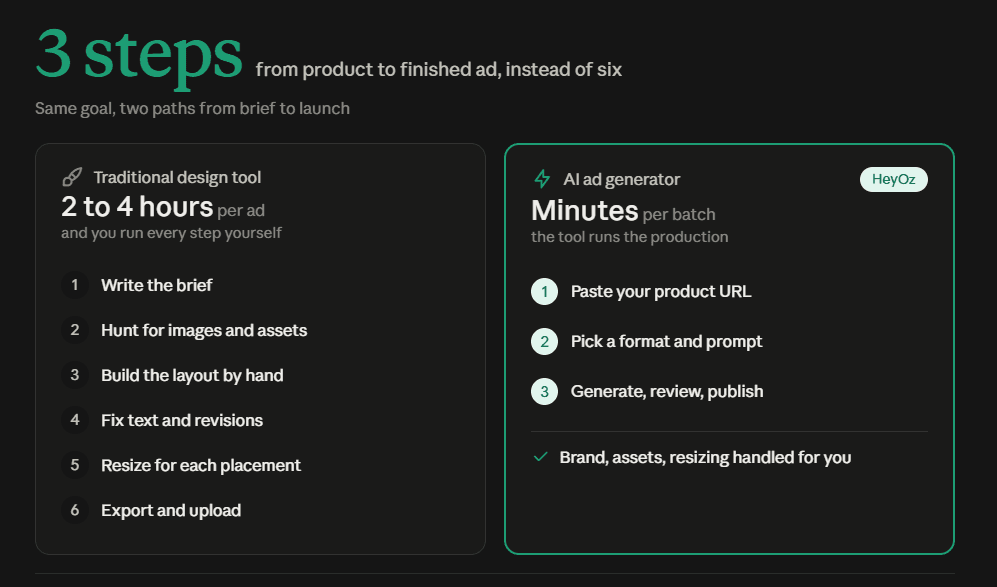
Speed matters for one reason beyond convenience. When an ad fatigues, you need a fresh one live fast. A three-week turnaround means you lose money while you wait.
Cost: Per Invoice vs Per Usable Ad
The real cost is not the software bill or the designer's invoice. It is the cost per usable ad. Most ecommerce owners are shocked to find they spend $200 to $500 per ad once they count their own hourly rate and design time. AI generators cut that. Production cost per asset drops from $50 to $500 down to $5 to $50, a 5 to 10 times reduction at the asset level. Watch out for one trap. A cheap AI design tool that still makes you write prompts, fix layouts, and rebuild every concept has not removed the cost. It just moved the work back onto your team. Count usable selling ideas, not generated files.
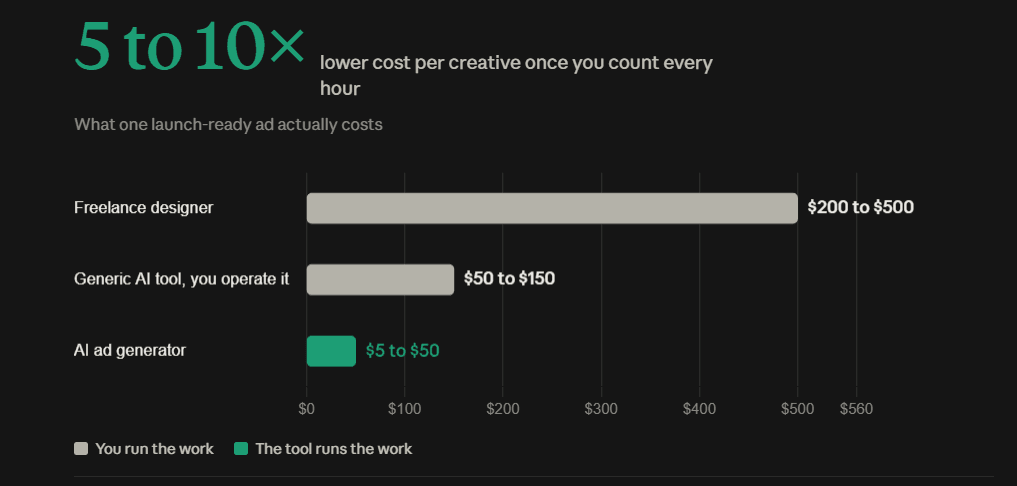
Here is the piece people miss. Lower cost per ad is not only about saving money. It buys you more tests, which buys you more chances to find a winner.
Output and Quality: Where Each One Wins
Neither tool wins across the board. They are good at different jobs.
Design tools win on originality. A strong designer brings taste, can invent a brand world from nothing, and handles complex compositing and retouching that AI cannot match yet. For a hero brand campaign where every pixel matters, that judgment earns its budget.
AI generators win on volume and iteration. They produce many finished directions fast, which is exactly what performance testing needs. For direct-response ads and high-volume testing, AI is the practical default.
The mistake is using the expensive option for the routine job. Do not burn a senior designer on the 30th variation of a product ad. Do not expect an AI generator to invent your next brand identity. Match the tool to the work.
When to Use Each One
A simple rule keeps you out of trouble.
- Use a design tool when the brand needs a new creative direction or a high-stakes hero asset.
- Use an AI ad generator when the product already exists and you need finished ads to test.
- Use a generic AI design tool only if your team actually wants to run the design process.
- Use both when you want taste at the top and speed underneath it.
The best teams in 2026 run this split. Designers handle brand-defining work. An AI generator handles the repeat batches that keep the testing pipeline full. Your designer gets leverage. Your media buyer gets ads.
How to Make AI Ads With HeyOz
Here is the actual workflow for turning a product into a batch of finished ads.
- Paste your product URL. HeyOz reads your products, brand colors, and voice, so every ad starts on-brand.
- Open the Content Studio and pick a format. Choose UGC hook video, static ad, product reshoot, AI avatar, or carousel based on your goal.
- Write a short prompt, or drop in a viral ad you want to match. HeyOz rebuilds the structure around your product.
- Pick an AI model and generate several variations in one session.
- Review, then publish or schedule straight to Instagram, TikTok, or YouTube.
Why Teams Pick HeyOz for the AI Side
- One login makes video, static, UGC, avatars, and product shots, so you skip five separate tools.
- Ads come out on-brand because HeyOz learns your brand from your website first.
- Generate many variations fast, so you can hit the 20 to 50 monthly test volume that wins on Meta.
- Publish straight to Instagram, TikTok, and YouTube without leaving the platform.Pricing starts at $19.99 a month, far below one freelance ad, with 3 free ads on signup and no card needed.
FAQs
What is the difference between AI ad generators and traditional design tools for ads?
An AI ad generator builds the ad for you from a product URL or prompt, handling the copy, visuals, and resizing. A traditional design tool like Photoshop or Canva is a canvas you build on yourself. The core difference is who does the production work. AI is faster and cheaper for volume. Design tools give more control for original brand work.
Are AI ad generators better than designers?
Not better, different. AI wins on speed, cost, and testing volume. Designers win on original art direction and brand-defining creative. Most high-performing teams use AI for volume and designers for hero assets.
How much cheaper are AI ad generators?
They cut the cost per usable ad by about 5 to 10 times. A designer-made static ad often costs $200 to $500 once you count hours and revisions. AI brings that down to roughly $5 to $50 per asset.
Will AI ad generators replace designers?
No. They remove the repeat production work so designers can focus on brand direction and high-value creative. Strategy and taste still need people. The tool handles volume; your team handles judgment.
About the author
Ahad Shams
Ahad Shams is the Founder of HeyOz, an all-in-one ads and content platform built for founders and small teams. He has worked across consumer goods and technology, with experience spanning Fortune 100 companies such as Reckitt Benckiser and Apple. Ahad is a third-time founder; his previous ventures include a WebXR game engine and Moemate, a consumer AI startup that scaled to over 6 million users. HeyOz was born from firsthand experience scaling consumer products and the need for a unified, execution-focused marketing platform.