


Key Takeaways
- Veo 3.1 is Google DeepMind's flagship video generation model, released October 15, 2025. It produces 1080p footage with synchronized audio, accurate physics, and reference image support.
- Video ads outperform static ads on engagement by a wide margin. Video drives 35 to 50% higher ROAS on cold audiences, according to MHI Growth Engine's Q4 2025 Meta data.
- Veo 3.1 video ads work best when you treat the prompt like a shot list. Describe the subject, the lighting, and the camera behavior, and give the model a product image as a reference.
- Inside HeyOz, you can generate Veo 3.1 ads in minutes with clean exports, no watermark, and direct publishing to Meta, TikTok, and YouTube.
- HeyOz includes Veo 3.1 alongside Sora 2, Kling 2, and Seedance 1 under one subscription starting at $44.99 a month.
Introduction
Video viewers retain 95% of a message versus 10% for text or static, according to Forbes and Insivia. That gap is why brands keep pouring budget into video ads, and why making them faster has become a real competitive advantage. Veo 3.1 is the tool changing the production math, and HeyOz is the place to run it.
What Veo 3.1 Actually Brings to Video Ads
Most AI video tools produce footage with tells. Lighting that does not quite make sense. Motion that drifts. Objects that change shape between frames. You notice. Your customer notices faster.
Veo 3.1 is Google DeepMind's answer to that problem. Released October 15, 2025, the model produces 1080p video at 24 fps with synchronized native audio, accurate motion physics, and improved frame-to-frame consistency over earlier versions. That last point matters more than it sounds. Earlier models had visible quality dips at the start and end of clips. Veo 3.1 holds the motion steady across the full duration.
A few things make Veo 3.1 specifically useful for ad creative:
- Reference image support. Upload up to three product or character images and the model uses them as the visual base for the scene. Your product looks like your product, not an approximation.
- Native synchronized audio. Dialogue, sound effects, and ambient sound generate alongside the visuals in a single pass. No separate dubbing step.
- Camera direction through prompts. Slow push, handheld tracking, locked-off rotation. The model reads camera intent from your description.
- Vertical and horizontal formats. True 9:16 composition for TikTok and Reels, 16:9 for YouTube and product pages.
That combination is why ad teams have started reaching for Veo 3.1 over older models when the goal is cinematic-quality output.
Why Cinematic Ad Footage Actually Sells Better
Static ads still have their place, especially for retargeting and bottom-of-funnel conversion. But when the goal is reach, recall, and pulling cold traffic into the funnel, video wins.
Here is what the data looks like. ATTN Agency's 2026 benchmarks show video ads on Meta hit 1.9% CTR versus 1.1% for static. Engagement runs 5.2% on video versus 1.4% on static. On Instagram feed specifically, video posts achieve 0.88% CTR versus 0.61% for single image ads, a 44% performance gap, per Focus Digital Research.
Velacore's 2025 data goes further. Short-form video ads deliver 58% higher CTRs and clicks up to 480% cheaper compared to static.
There is a reason cinematic-quality footage outperforms generic AI clips. The viewer's brain reads the production value as a signal of brand quality. Footage that looks shot on a real set with real lighting earns trust. Footage that looks generated does the opposite, no matter how clever the copy is.
That is the bar Veo 3.1 video ads can actually hit, which is what separates this model from older AI video tools that produced output you would not run as paid creative.
How to Write a Veo 3.1 Prompt That Produces Ad-Ready Footage
Most brands lose the quality Veo 3.1 promises in the prompt. A vague prompt produces vague output. A directed prompt produces footage that looks shot.
Treat the prompt like a shot list a director would write for a camera operator. Four elements to include every time:
- The subject and its placement. What is in the frame, where it sits, what surface it rests on.
- The lighting. Golden hour, soft window light, studio bounce, dramatic side light. The lighting language sets the mood.
- The camera behavior. Slow push in, subtle orbit, locked-off shot with shallow depth of field. This is the piece most brands skip.
- The motion or action. What is moving, how fast, in what direction.
Weak prompt
A video of my candle for an Instagram ad.
Strong prompt
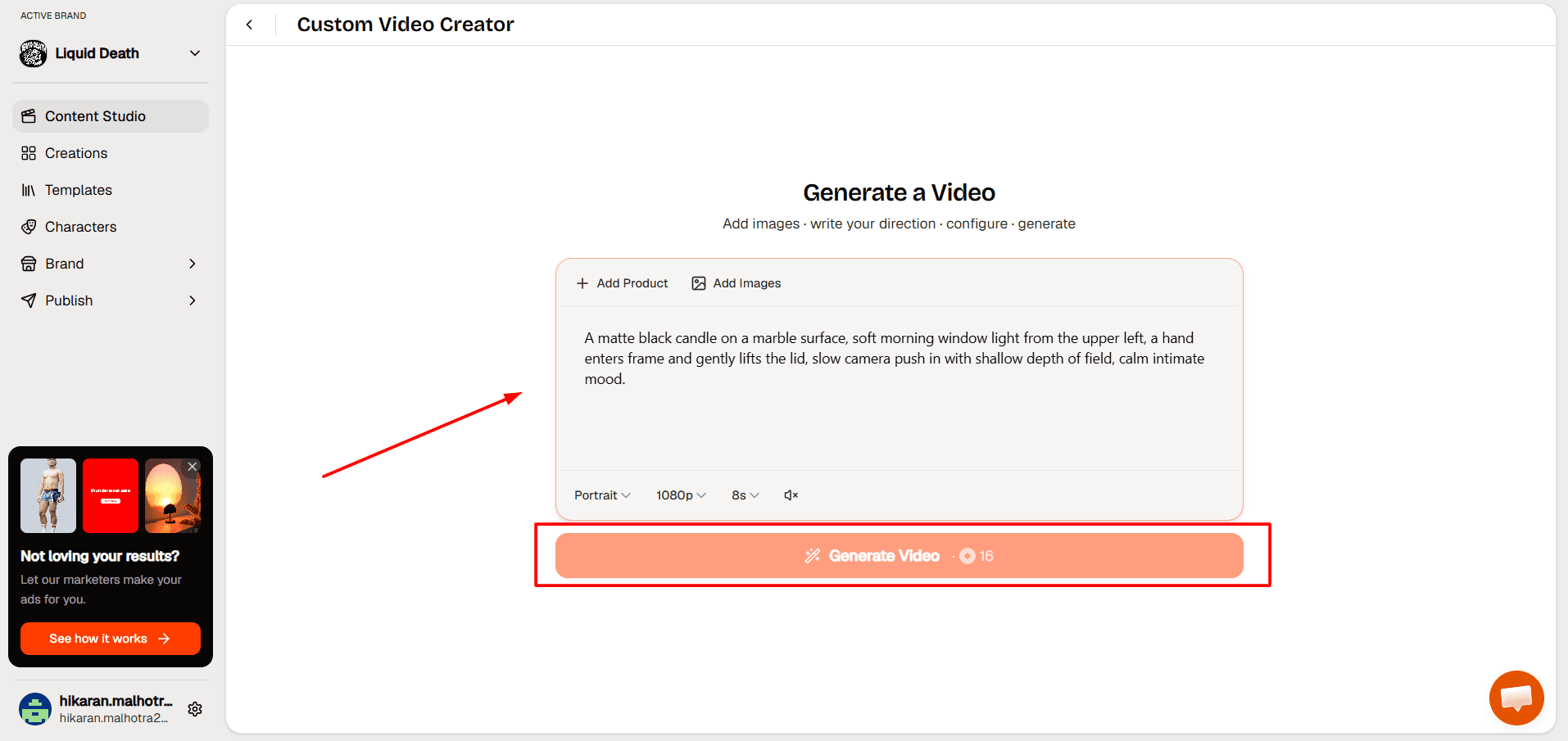
A matte black candle on a marble surface, soft morning window light from the upper left, a hand enters frame and gently lifts the lid, slow camera push in with shallow depth of field, calm intimate mood.
The second prompt produces footage you can run as a paid ad. The first one produces something that goes in the trash.
One more practical tip. Upload your product image as a reference inside HeyOz before generating. Veo 3.1 uses that image as the visual base for the scene, which keeps your product looking like your product instead of a model's guess at what you described.
How to Use Veo 3.1 for Video Ads Inside HeyOz
HeyOz puts Veo 3.1 directly inside your content workflow. No separate Google account, no API setup, no juggling export pipelines. Generation, editing, and publishing all happen in the same dashboard.
Here is the step by step process:
- Add your product. Paste your product page URL or upload your product image. HeyOz reads the page and pulls in your product details, brand colors, and assets automatically. Open the Content Studio.
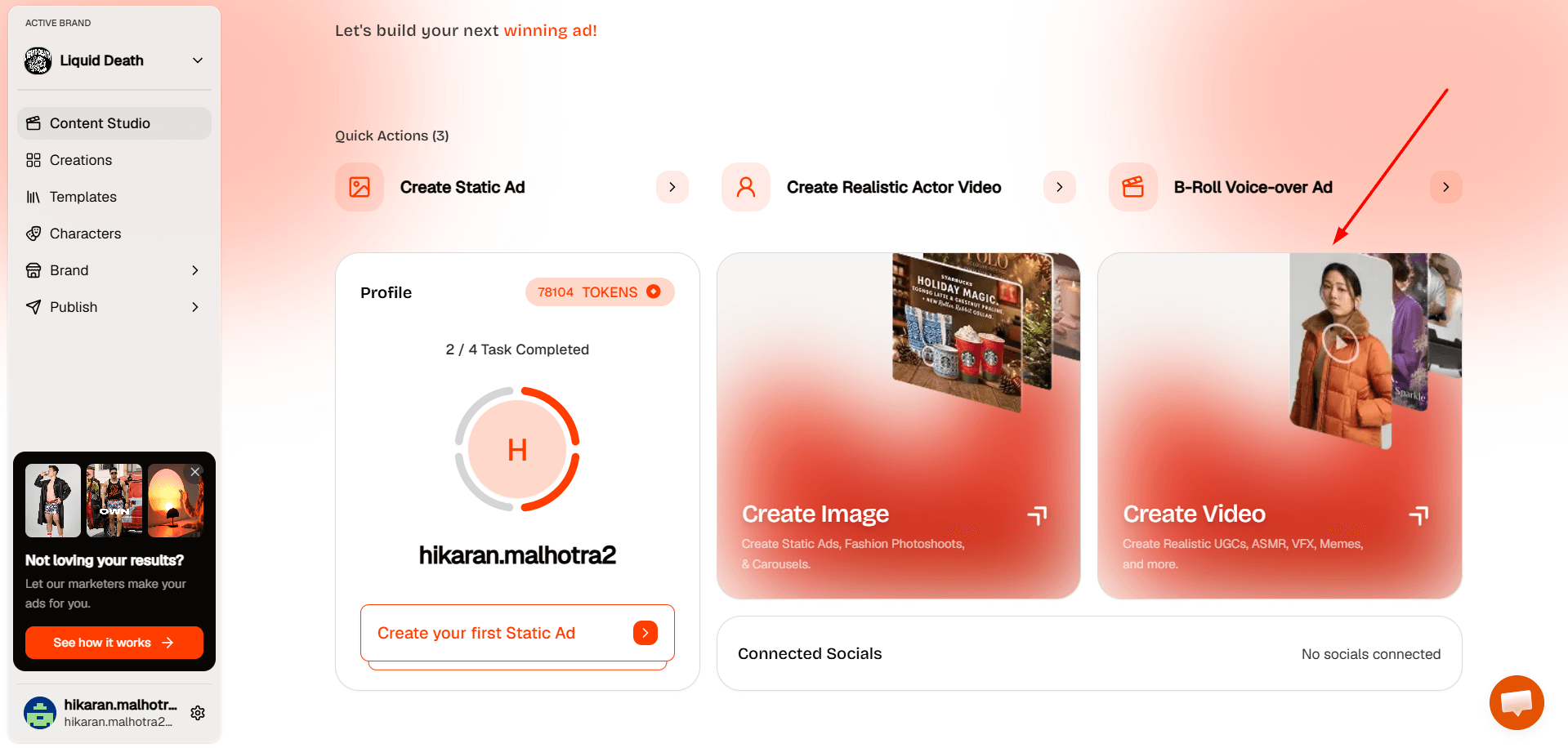
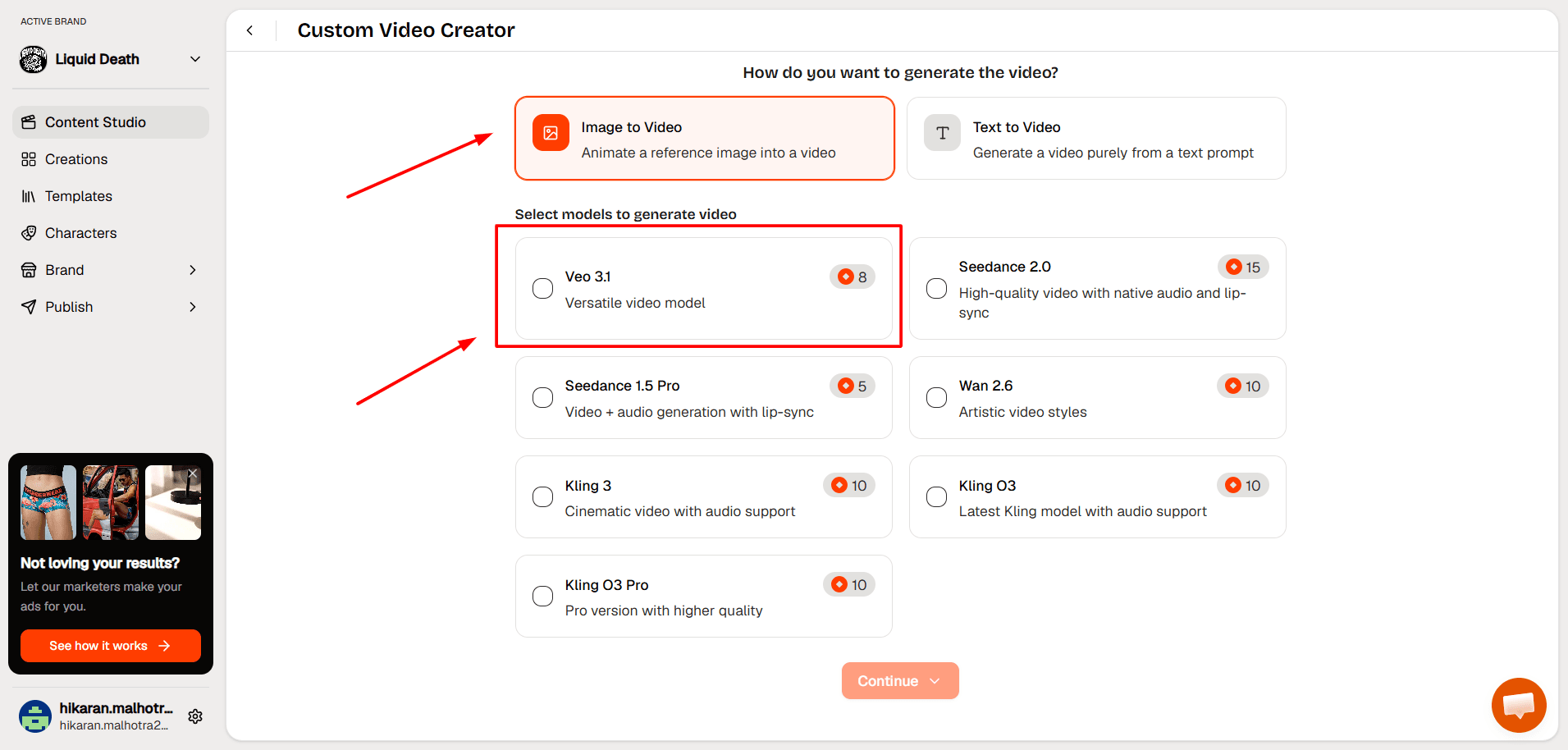
2. Select the Video Generator format and pick Veo 3.1 from the available models.
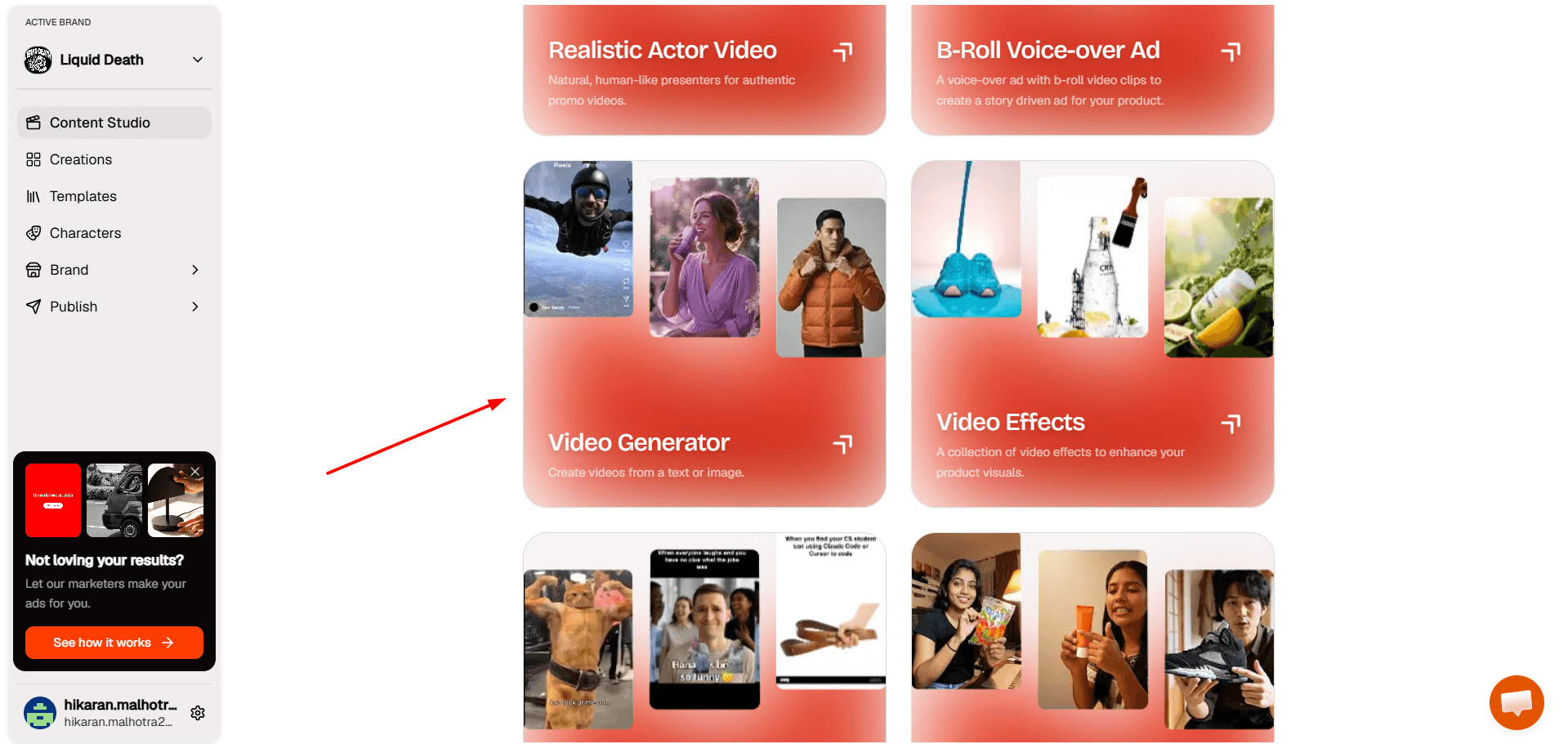
3. Upload your image. Choose a product image from your Brand Assets or upload a new one. Veo 3.1 uses this as the visual reference for the scene.
4. Write your scene description. Describe the subject, the lighting, the motion, and the camera angle. Set format and generate. Pick portrait 9:16 for TikTok and Reels or landscape 16:9 for YouTube and product pages, then choose 720p or 1080p. Click Create. Preview the result, edit if needed, and download or publish directly to your social accounts.
What you get from running Veo 3.1 inside HeyOz:
- Access to Veo 3.1 alongside Kling 2, Sora 2, and Seedance 1 in one subscription, starting at $44.99 a month.
- Clean watermark-free exports, ready to run as paid ads on Meta, TikTok, and YouTube without any extra cleanup steps.
- Built-in video editor for trimming, adding text overlays, swapping music, and adjusting pacing without leaving the platform.
- Direct publishing to TikTok, Instagram, YouTube, and Facebook from the same dashboard you used to generate the video.
- Automatic product page scraping that pulls your existing images and brand details, so you skip the manual setup step for every new ad.
Want to see what it looks like in practice? Try Veo 3.1 inside the HeyOz Content Studio at heyoz.com.
The Production Math Brands Cannot Ignore
A traditional cinematic ad shoot still runs $5,000 to $50,000 per spot depending on talent, locations, and post-production. Most DTC brands cannot run that math on five to ten ad variations a week, which is what the algorithms actually need to find a winning hook.
Veo 3.1 video ads cut that cost down to the minutes it takes to write a good prompt. HeyOz puts the model, the editor, and the scheduler in one place at $44.99 a month, which is what makes the workflow actually usable at the pace ad testing demands.
The brands testing more creative win. The model that makes testing affordable wins their budget.
FAQs
Can I use Veo 3.1 video ads on Meta and TikTok as paid creative?
Yes. Veo 3.1 outputs generated through HeyOz export clean with no watermark and full commercial use rights. Brands run them as paid ads on Meta, TikTok, YouTube, and other platforms without additional licensing steps. The model's 9:16 and 16:9 outputs are sized correctly for each placement.
How is Veo 3.1 different from Sora 2 or Kling 2 for ad creative?
Veo 3.1 leads on photorealism, native synchronized audio, and frame-to-frame consistency. Sora 2 handles a wider stylistic range, including stylized and cinematic looks. Kling 2 has the strongest motion physics for product handling and lifestyle scenes. Inside HeyOz you can test all three on the same ad brief without paying for separate subscriptions.
Does Veo 3.1 generate sound and dialogue for video ads automatically?
Yes. Veo 3.1 produces synchronized native audio in the same generation pass, including dialogue, sound effects, and ambient sound. That removes the manual dubbing step that older AI video models required, which is one of the biggest time savings the model offers for ad production.
How long does a Veo 3.1 ad take to generate inside HeyOz?
Most clips finish in a few minutes. The exact time depends on resolution, length, and prompt complexity. For most ad use cases, brands go from product image to a finished video ready to post in under ten minutes per clip.
About the author
Ahad Shams
Ahad Shams is the Founder of HeyOz, an all-in-one ads and content platform built for founders and small teams. He has worked across consumer goods and technology, with experience spanning Fortune 100 companies such as Reckitt Benckiser and Apple. Ahad is a third-time founder; his previous ventures include a WebXR game engine and Moemate, a consumer AI startup that scaled to over 6 million users. HeyOz was born from firsthand experience scaling consumer products and the need for a unified, execution-focused marketing platform.