

Key Takeaways
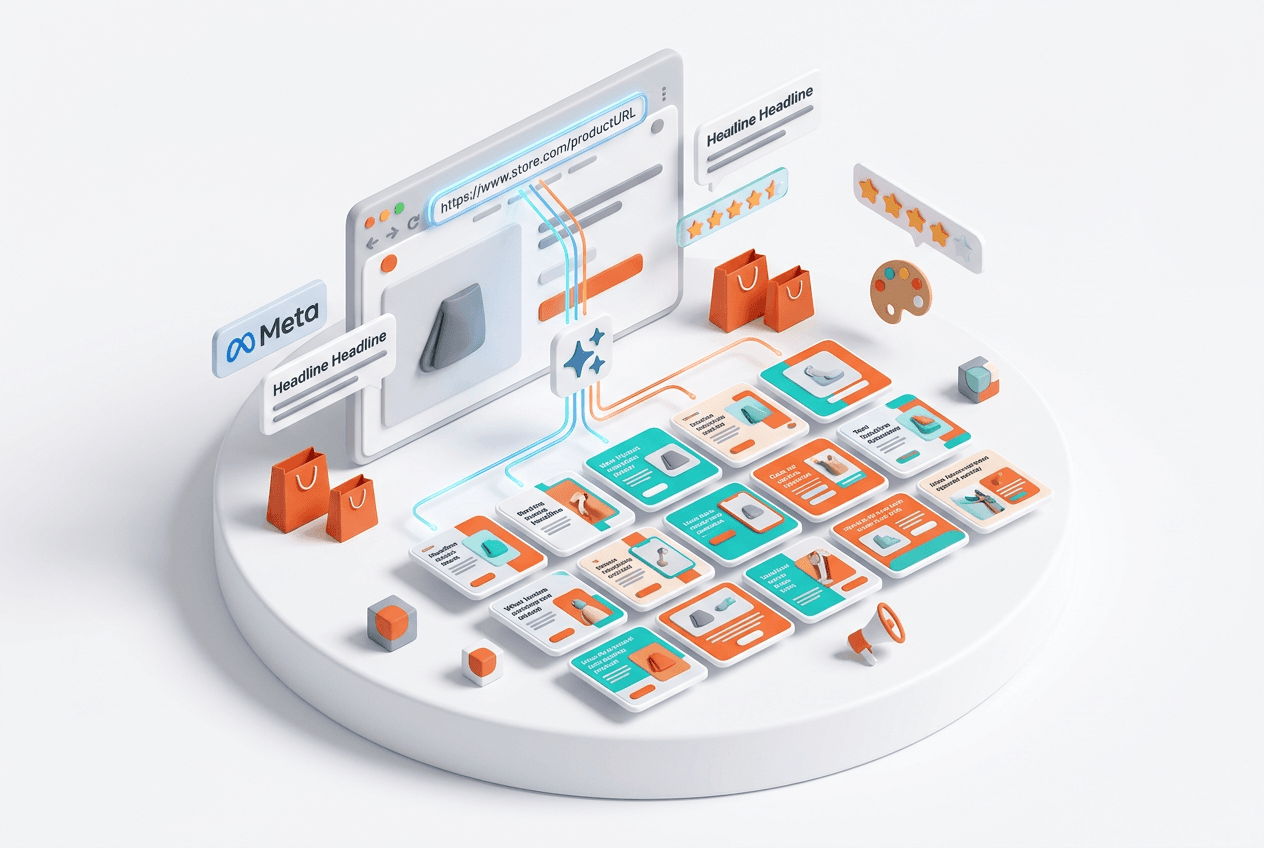
- One product URL produces 60 static ad variations in 12 minutes using Claude for ideation and HeyOz for visual production — no designer, photographer, or studio needed.
- Claude generates 60 headline angles across 6 hook categories (problem-aware, benefit-led, social proof, direct offer, curiosity, comparison), then scores and filters to the top 20.
- HeyOz auto-imports your product images, brand colors, and positioning from the URL, then renders finished on-brand static ads from templates.
- Total cost: $65/month (Claude Pro $20 + HeyOz Basic $45) vs $2,300-4,500 for 3-5 ads the traditional way. That is 10x the volume at 1/30th the cost.
- The workflow compounds over time — feed your winners back into Claude each cycle and every new batch builds on proven patterns.
Introduction
I pasted one product URL. Got 60 static ads back. 12 minutes, end to end. No designer. No photographer. No studio.
The old way: book a product photoshoot for $3,000+, wait 2 weeks for the photos, brief a designer on headlines and layouts, go through 5 rounds of revisions, and end up with 3-5 static ads. Total time: 4-6 weeks. Total cost: $5,000+ for a handful of ads.
The new way: paste the product URL into HeyOz, use Claude to generate and score 60 different headline angles, let HeyOz render each winning angle as a finished static ad, and upload to Meta. Total time: 12 minutes. Total cost: $65/month for every product you sell.
This guide gives you the exact workflow, the exact prompts, and the full setup to start using today.
Why Are Static Ads a Volume Game?
Static ads on Meta are not won by one perfect design. They are won by testing 20+ angles against the same product and letting Meta's algorithm find the winner. The brands scaling profitably right now are producing 20-60 variations per product, launching them all, killing the losers fast, and doubling down on the winners.
The problem has never been ideas. Any decent marketer can come up with 60 headline angles given enough time. The bottleneck is production cost per variation. When every static ad requires a photoshoot, a designer, and 5 rounds of revisions, you can afford 3-5 variations. Not 60.
This workflow eliminates both bottlenecks. Claude handles ideation — 60 scored angles in under a minute. HeyOz handles production — finished, on-brand ads rendered from your actual product images. Together, they turn a 4-6 week project into a 12-minute job.
What Do You Need Before Starting?
Required:
- A Claude Pro account ($20/month) — sign up at claude.ai
- A HeyOz account ($44.99/month for Basic with 200 tokens, or $99.99/month for Pro with 500 tokens) — sign up at heyoz.com with a 3-day free trial
- A product URL — your product page on Shopify, Amazon, WooCommerce, or any e-commerce platform
That is it. No Figma. No Canva. No design software. No photographer. No agency.
What Is the 5-Step Workflow?
Step 1: Paste Your Product URL Into HeyOz
Go to heyoz.com and log in. Click to add a new product. Paste your product URL. HeyOz reads the page automatically and extracts product images, product name and description, price and offers, brand colors and typography, and key benefits. This becomes your creative brief, built directly from your own site. No manual brief writing needed. For most well-built product pages on Shopify, WooCommerce, or Amazon, the auto-import captures everything you need.
Step 2: Generate 60 Ad Angles With Claude
Open Claude and give it the product context. Ask for 60 angles organized across 6 hook categories with 10 variations per category: Problem-Aware (lead with the pain point), Benefit-Led (lead with the outcome), Social Proof (lead with credibility and numbers), Direct Offer (lead with the deal or price), Curiosity (create an information gap), and Comparison (position against alternatives). For each angle, request a headline under 40 characters, primary text under 125 characters, and a suggested CTA. Claude outputs all 60 in under a minute. The full copy-paste prompt is in the prompts section below.
Step 3: Score and Filter the Top 20
In the same Claude session, ask it to score each angle 1-10 on three criteria: Brand Fit (does the tone match your brand), Hook Strength (would it stop a thumb-scroller), and Meta Placement Compliance (character limits, no restricted language). Claude ranks all 60 by average score and flags the top 20. Out of 60 angles, expect 15-25 to be strong. The scoring step filters to the best so you only produce ads worth testing.
Step 4: Render the Visuals in HeyOz
Go back to HeyOz, select your product, and choose the Static Ad format. For each of your top 20 angles: select a template that matches the angle type, paste the headline and primary text from Claude, choose the best product image (hero shot for benefit-led, lifestyle for problem-aware, detail for comparison), and generate. HeyOz applies your brand colors automatically and renders a finished ad. Once you find a template you like, batch-produce multiple angles using the same template with different headlines. Export at 1080x1080 (feed), 1080x1350 (4:5 feed vertical), or 1080x1920 (stories/reels).
Step 5: Upload to Meta and Test
Export all finished ads and upload to Meta Ads Manager. Create one campaign with a single ad set targeting your core audience. Add all 20 creatives as individual ads. Set a daily budget of $5-10 per ad for the first 3-4 days. After 3-4 days, kill anything with CTR below 1% and no conversions, keep running above-average performers, and scale the top 3-5 into dedicated ad sets with higher budgets. Then feed your winners back into Claude to generate 20 more variations building on the winning patterns. Every cycle gets smarter because your input data improves.
What Are the Exact Claude Prompts?
Prompt 1: Generate the Angle Matrix
Tell Claude: I need 60 static ad headline/angle variations for this product: [product name, URL, price, key benefits, target audience]. Generate 60 angles across 6 hook categories (10 per category): Problem-Aware, Benefit-Led, Social Proof, Direct Offer, Curiosity, Comparison. For each angle provide a headline under 40 characters, primary text under 125 characters, and a suggested CTA. Make each angle distinct.
Prompt 2: Score and Rank
Tell Claude: Score each of the 60 angles 1-10 on Brand Fit, Hook Strength, and Meta Placement Compliance. Rank all 60 by average score. Flag the top 20. Note any issues for angles scoring below 5 on any criterion. Output as a table.
Prompt 3: Iterate on Winners
After running ads for 3-4 days, tell Claude: My top performing ads used these angles: [paste your 3 winning headlines]. Generate 20 new variations that build on these winning patterns. Same hook category and emotional trigger, but test different phrasing, numbers, claims, supporting text, and CTAs. Keep headlines under 40 characters and primary text under 125.
Prompt 4: Seasonal Variations
Tell Claude: Take my top 10 performing static ad angles and create seasonal variants for [event — Black Friday, Summer Sale, etc.]. Adapt the headline to reference the event, update the offer or urgency, keep the core hook category the same, and adjust the CTA. Output 10 seasonal variants with headline, primary text, and CTA.
How Many Ads Should You Actually Test?
The answer depends on your budget. Under $1,000/month ad spend: start with 10-15 static ads per product, using the scoring step to pick only the strongest angles. You need enough budget per ad to gather meaningful data.
$1,000-5,000/month: test 20-30 variations per product. This is the sweet spot where volume testing starts to reliably surface winners.
$5,000+/month: test 40-60 variations. At this budget level, the cost of producing more creatives is negligible compared to the value of finding a high-ROAS creative one week earlier.
The math: if producing 60 static ads costs $65/month and testing them helps you find a creative that improves your ROAS by even 10%, the payback on a $5,000/month ad budget is $500/month in improved returns. The tool cost is irrelevant.
What Are the Best Tips for Better Results?
Give Claude specific product details.
"Wireless earbuds" produces generic angles. "40-hour battery, ANC, $49.99, rated 4.8 stars by 12,000 customers" produces specific, compelling angles. The more concrete data you feed in, the better the output.
Use your actual customer language.
Before generating angles, paste 5-10 real customer reviews from your product page into Claude. Tell it to use the exact language and pain points from these reviews. This produces angles that resonate because they come from real buyers.
Test across hook categories, not just within them.
Your biggest insight will not be that headline A beats headline B. It will be that curiosity hooks outperform benefit-led hooks 3:1 for this product. That changes your entire creative strategy.
Match the image to the angle.
A problem-aware headline works best with a lifestyle image showing the frustration. A benefit-led headline works best with a clean product shot. A social proof headline works best with a review screenshot or trust badge layout. The visual should reinforce the hook, not fight it.
Refresh every 2-3 weeks.
Even winning creatives fatigue. Run this workflow every 2-3 weeks with new angles. Feed your winners back into Claude each time so the next batch builds on proven patterns.
What Does This Cost vs the Old Way?
The old way:
Product photoshoot: $1,500-3,000. Designer for 5 static ads: $500-1,000. Copywriter for headlines and copy: $300-500. Revisions and back-and-forth: 2-4 weeks. Total: $2,300-4,500 for 3-5 ads.
The new way:
Claude Pro: $20/month. HeyOz Basic: $44.99/month. Photoshoot: $0 (HeyOz uses your existing product images and can generate AI product photoshoots). Designer: $0 (HeyOz renders finished ads). Copywriter: $0 (Claude generates and scores all copy). Total: $65/month for unlimited static ads.
The old way gives you 3-5 ads per cycle. The new way gives you 20-60 per cycle. You produce 10x the creative volume at a fraction of the cost.
Frequently Asked Questions
Do I need design skills?
No. HeyOz handles all the visual production. You select a template, paste in your headline, and it renders a finished ad using your product images and brand colors. If you can copy-paste text, you can make static ads.
What if my product page does not have great images?
HeyOz has built-in AI product photoshoot tools. You can generate professional product images from your existing photos with different backgrounds, lighting, angles, and environments. No photographer needed.
Can I use this for multiple products?
Yes. Run the workflow separately for each product. Claude generates product-specific angles based on each product's unique benefits and audience. Most brands run this for their top 3-5 products and cycle through them.
Will all 60 angles be good?
No. That is exactly why the scoring step exists. Out of 60 angles, expect 15-25 to be strong, 20-30 to be average, and 10-15 to be weak. The scoring filters to the top 20 so you only produce ads worth testing.
Can I use this for video ads too?
This guide covers static ads specifically. HeyOz also produces AI UGC videos, talking head videos, slideshow videos, and B-roll voiceovers. The same Claude angle-generation workflow works for video scripts — just change the output format from headlines to video scripts.
How long before I see which ads are winning?
Give each ad 3-4 days on Meta with $5-10 per ad per day. After that window, winners and losers will be clear from CTR, CPA, and ROAS data.
Does HeyOz export in the right sizes for Meta?
Yes. Templates are built for Meta specs. Feed ads at 1080x1080 or 1080x1350, Stories and Reels at 1080x1920. You can also customize dimensions if needed.
About the author
Ahad Shams
Ahad Shams is the Founder of HeyOz, an all-in-one ads and content platform built for founders and small teams. He has worked across consumer goods and technology, with experience spanning Fortune 100 companies such as Reckitt Benckiser and Apple. Ahad is a third-time founder; his previous ventures include a WebXR game engine and Moemate, a consumer AI startup that scaled to over 6 million users. HeyOz was born from firsthand experience scaling consumer products and the need for a unified, execution-focused marketing platform.